A guide to the 10 interview types (and when to use each)
Screening, technical, system design, behavioral and more: a practical breakdown of the ten interview types, what each one tests and how to sequence them.
By the Hyre Mate team
Quick answer
The ten common interview types are screening, aptitude test, coding assignment, technical, system design, case study, behavioral, managerial, HR and final interviews. Each answers a different question about a candidate, so a good hiring process uses a few of them in sequence: quick, low-cost filters such as screening and aptitude tests first, in-depth skill assessments such as technical, system design or case study rounds in the middle, and judgment-focused behavioral, managerial and final rounds at the end.
Key takeaways
- Each interview type answers one question about the candidate. Pick types by what you need to learn.
- Put cheap, fast filters early and expensive, in-depth rounds later.
- Three to five rounds is enough for most roles. Every round should assess something no other round does.
- Use the same scorecard and rating scale across rounds so results are comparable.
- Different roles need different sequences: an engineer's loop looks nothing like a salesperson's.
Not every interview should do the same job. A well-designed process uses different interview types at different stages, each answering a specific question about the candidate. Here's what each of the ten common types is for, and how to put them together.
What are the main types of job interviews?
| Interview type | What it assesses | Typical length | Usually run by |
|---|---|---|---|
| Screening | Basic fit, motivation, logistics | 15–30 min | Recruiter |
| Aptitude test | Reasoning and problem-solving ability | 30–60 min | Online test or recruiter |
| Coding assignment | Real work output in code | 2–4 hours, take-home | Engineering team reviews |
| Technical | Depth in the role's tools and concepts | 45–60 min | Senior team member |
| System design | Architecture and trade-off thinking | 45–60 min | Senior or staff engineer |
| Case study | Structured problem-solving on a realistic scenario | 45–90 min | Hiring manager or team |
| Behavioral | How the candidate has handled real situations | 45–60 min | Hiring manager or peer |
| Managerial | Leadership, ownership and prioritization | 45–60 min | Senior leader |
| HR | Culture, compensation and logistics | 30–45 min | HR partner |
| Final | Alignment between decision-makers | 30–60 min | Department head or founder |
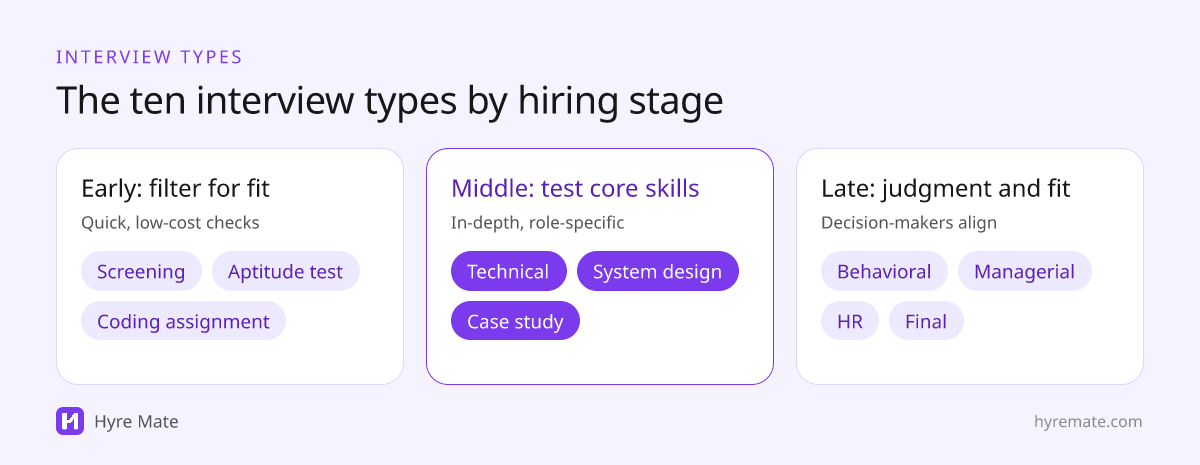
Early stages: which interviews filter for basic fit?
Screening
A short first call to confirm must-haves, motivation, location, availability and salary expectations. It's the cheapest filter in your process, so keep it consistent and quick. Our phone screen guide includes a 30-minute script.
Aptitude test
Tests of reasoning, numerical or verbal ability, useful when raw problem-solving matters and candidates have varied backgrounds, such as graduate programs. Use validated tests and apply them to everyone in the same pool.
Coding assignment
A practical take-home or timed task that shows real work rather than talk. Keep it short and relevant to the job, explain how it will be assessed, and respect candidates' time; long unpaid assignments put off strong people.
Middle stages: which interviews test core skills?
Technical interview
A deep conversation about the tools, concepts and decisions the job involves. The best technical interviews ask candidates to explain trade-offs in work they've done, not to recite definitions.
System design interview
For senior engineering and infrastructure roles: the candidate designs a system and talks through scale, reliability and trade-offs. You're assessing how they reason under ambiguity, not whether they reach one correct answer.
Case study interview
A realistic business problem worked through live, common in product, consulting, operations and sales roles. Share the context in advance if you want to test analysis rather than speed, and score the structure of the thinking.
Later stages: which interviews assess judgment and fit?
Behavioral interview
Questions about real past situations, such as "tell me about a time you…", scored against competencies like ownership, collaboration and communication. See our 30 behavioral interview questions for examples by competency.
Managerial interview
For people-leading roles: how the candidate sets direction, develops people, handles underperformance and makes trade-offs between priorities.
HR interview
Covers working style, values, compensation, benefits and practical details. Replace vague "culture fit" questions with the specific behaviors your team values.
Final interview
The closing conversation where decision-makers align and the candidate meets senior leadership. It should confirm the decision and sell the role, not re-test skills that earlier rounds already covered.
How do you choose which interview types to use?
Start from what you need to learn about the candidate, then pick the cheapest interview type that answers each question. Some example sequences:
| Role | Example sequence |
|---|---|
| Software engineer | Screening, coding assignment, technical, system design (senior roles), behavioral, final |
| Sales representative | Screening, case study or role-play, behavioral, managerial, final |
| Customer support | Screening, written exercise or aptitude test, behavioral, HR |
| Graduate or intern | Screening, aptitude test, case study or assignment, HR |
| People manager | Screening, behavioral, managerial, case study, final |
How many interview rounds should there be?
For most roles, three to five rounds is enough. More rounds rarely add new information; they usually re-test the same skills and slow the process down, which costs you candidates who accept other offers. A good rule: every round should own specific competencies that no other round assesses. If two rounds test the same thing, merge them. Our guide to reducing time to hire covers more ways to keep the process moving.
How do you design the sequence?
The art is in the order and the gates. Cheap, fast filters (screening, aptitude) go early so you don't spend expensive interviewer time on candidates who don't meet the basics. In-depth, expensive evaluations (system design, final) go later, only for candidates who have already cleared the bar.
- Put must-have checks first. If a skill is non-negotiable, test it in an early round.
- Decide the pass criteria for each round in advance, so moving forward isn't a judgment call made under time pressure.
- Tell candidates the full process up front, including the number of rounds and rough timeline.
- Avoid stacking similar rounds on the same day unless the candidate prefers it.
How do you keep scoring consistent across interview types?
Whatever sequence you choose, score each round the same way for every candidate. Use one interview scorecard for the role, assign each competency to a round, and have interviewers submit scores before the debrief. Structured scoring and notes turn a set of subjective conversations into a comparable, defensible decision, which is the core of a structured interview process.
Should every candidate go through the same rounds?
For the same role, yes. Comparing candidates fairly depends on assessing them on the same things, in a similar way. Exceptions should be deliberate and recorded: for example, skipping a coding assignment for an internal transfer whose work the team already knows, or offering an accommodation such as extra time on a test. What you should avoid is adding or dropping rounds based on a first impression of a candidate.
What are common mistakes when planning interview rounds?
- Testing the same thing twice, such as two technical rounds with overlapping questions.
- Leaving the hardest filter until last, so candidates who were never going to pass take up four rounds of interviewer time.
- Using unstructured "chats" for decisions. Informal conversations are fine for selling the role, not for scoring.
- Long unpaid assignments that strong candidates simply skip.
- Re-litigating earlier rounds in the final interview instead of trusting the evidence.
How does Hyre Mate support the ten interview types?
Hyre Mate supports all ten interview types. You can schedule interviews by type, filter them by type and status, and use the AI interview copilot to generate questions tailored to each round, with more, similar or follow-up questions on demand. After each interview, recordings and transcripts become AI notes, a written assessment and scores for technical skills, communication, problem-solving and cultural fit, so every stage is documented the same way.
Frequently asked questions
What are the different types of job interviews?
The ten common types are screening, aptitude test, coding assignment, technical, system design, case study, behavioral, managerial, HR and final interviews. Most hiring processes use three to five of them, depending on the role.
What is the difference between a technical and a behavioral interview?
A technical interview assesses job-specific knowledge and skills, such as how a candidate would design or debug something. A behavioral interview asks about real past situations to assess competencies like ownership, collaboration and communication.
How many interview rounds are normal?
Three to five rounds is typical for most roles. Senior or specialist roles sometimes have more, but each round should assess something the others don't.
What is a screening interview?
A short first-round call, usually 15 to 30 minutes, that confirms the candidate meets the role's must-haves and that the role matches what they're looking for, before full interviews begin.
What is a case study interview?
An interview where the candidate works through a realistic business problem, explaining their reasoning as they go. It's common in product, consulting, operations and sales roles.
Which interview type is most predictive of job performance?
Research on hiring methods ranks structured interviews highly: in a 2022 re-analysis by Sackett and colleagues, structured interviews had the highest average validity of the methods studied. Structure matters more than the format, so any interview type works better with standard questions and scoring.