How to write a job description that attracts the right candidates
How to write a job description that attracts the right people: what to include, how to write each section, an example, inclusive language and common mistakes.
By the Hyre Mate team
Quick answer
To write a good job description, start with a clear, searchable job title, then open with a short summary of what the person will achieve. List five to eight specific responsibilities, separate genuine must-have requirements from nice-to-haves, and include the practical details candidates look for: location or remote policy, employment type, experience level and, where you can, the pay range. Use plain, inclusive language and keep it easy to scan.
Key takeaways
- Use a standard, searchable job title. Creative titles hurt how many people find the role.
- Lead with what the person will do and achieve, not company boilerplate.
- Keep must-haves short and real; move everything learnable to nice-to-haves.
- Include location, employment type, experience level and pay where possible.
- A precise description also makes resume screening and interview questions more accurate.
A job description does more than list duties. It's a marketing document, a filter, and the foundation everything downstream is scored against. Get it right and the rest of your funnel gets easier: fewer unsuitable applicants, faster screening and better interviews.
What's the difference between a job description and a job posting?
| Job description | Job posting | |
|---|---|---|
| Purpose | Defines the role: responsibilities, requirements, level | Advertises the role to attract applicants |
| Audience | Hiring team, HR, the person in the role | Candidates |
| Tone | Precise and complete | Persuasive and scannable |
| Includes | Duties, requirements, reporting line, level | The description, plus why join, pay, benefits and how to apply |
In practice most teams publish a job description as the posting, so it needs to do both jobs: be accurate enough to score candidates against, and engaging enough that good people apply.
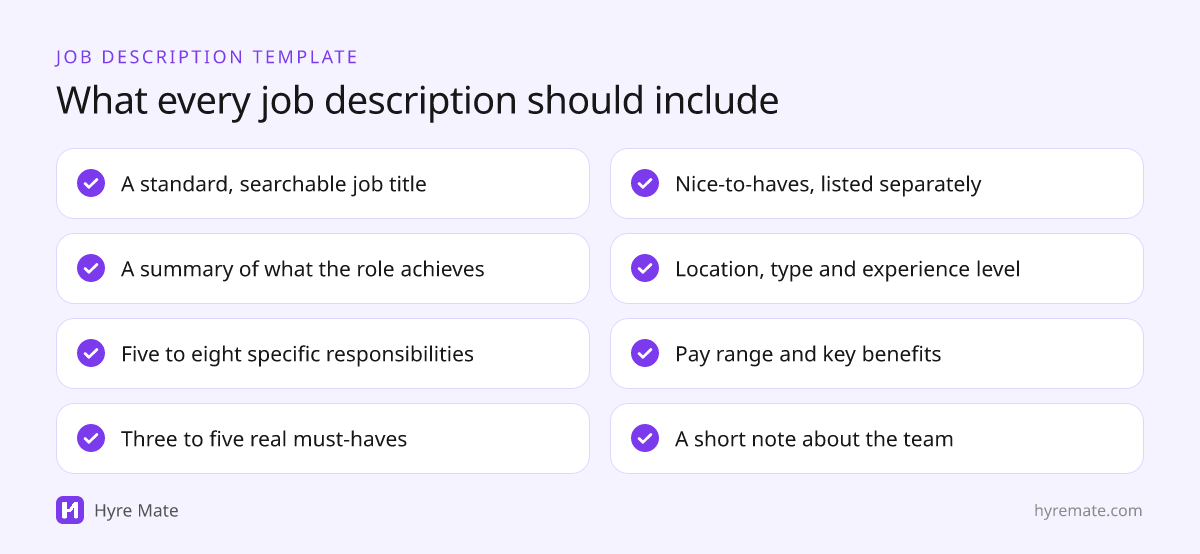
What should a job description include?
- Job title: the standard name people search for.
- Summary: two or three sentences on what the role exists to achieve.
- Responsibilities: five to eight specific things the person will do.
- Requirements: a short list of genuine must-haves.
- Nice-to-haves: skills that help but can be learned.
- Education: only if it's truly required, with equivalent experience accepted where possible.
- Skills: the tools and abilities the role relies on.
- Logistics: location or remote policy, employment type and experience level.
- Pay and benefits: the salary range and key benefits, where you can share them.
- About the team and company: short, and after the role details.
How do you write each section?
Job title
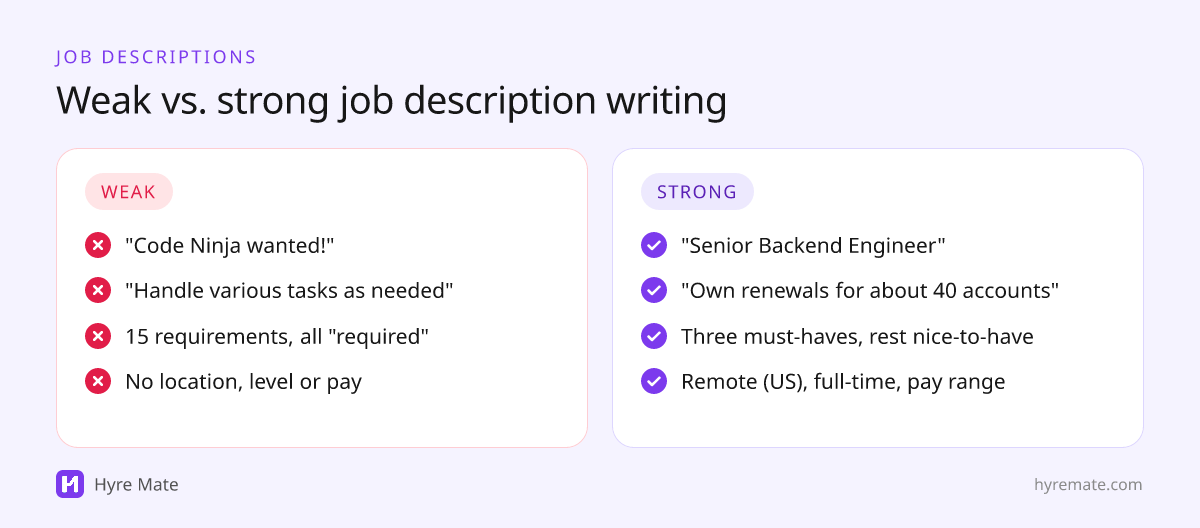
Use the title candidates actually search for. "Senior Backend Engineer" will be found; "Code Wizard" won't. Add the level (junior, senior, lead) and the key specialty if it matters, but avoid internal jargon and grade codes.
Summary
Candidates skim. Put the most important information, what they'll actually do and why it matters, at the top, before the standard company paragraph. A good summary answers: what will this person own, and what will success look like in their first year?
Responsibilities
Vague responsibilities ("handle various tasks") attract vague applications. Concrete ones help the right people recognize themselves. Start each with a verb and include scale where you can: "Own renewals for around 40 mid-market accounts" beats "Manage customer relationships".
Requirements and nice-to-haves
Long requirement lists put off strong candidates, especially those who rule themselves out if they don't tick every box. Be explicit about what's genuinely required versus a bonus:
- Must-have: the skills the person cannot succeed without from day one.
- Nice-to-have: everything else that would help but can be learned on the job.
Skills and education
List the specific tools and abilities the role relies on, such as "SQL", "Figma" or "negotiating annual contracts", rather than broad traits like "hard-working". For education, ask whether a degree is truly needed to do the job. If it isn't, say so, or write "degree or equivalent experience". Unnecessary degree requirements narrow your pool without telling you much about ability, and they're easy to remove.
Location, type and level
State whether the role is remote, hybrid or on-site and where, whether it's full-time, part-time, contract, an internship or freelance, and the experience level you're hiring for. Missing logistics is one of the fastest ways to attract applicants who can't take the job.
Pay
Including a salary range attracts better-matched applicants and saves time on both sides. In a growing number of places it's also required: several US states, including California, Colorado, New York and Washington, have pay transparency laws covering job postings, and the EU's Pay Transparency Directive, which member states are bringing into national law, requires applicants to be told the pay or pay range before the interview. Check the rules where you hire.
Job description example
Example: Customer Success Manager
Customer Success Manager (Mid-Market) · Full-time · Remote (US) · 3+ years' experience · $75,000–$90,000
About the role: You'll own the relationship with around 40 mid-market customers, making sure they get value from the product, renew and grow. Success in year one means strong renewal rates on your book and customers who'd recommend us.
What you'll do: run onboarding for new accounts; hold quarterly business reviews; spot churn risks in usage data and act early; manage renewals and expansion conversations; feed customer insights to the product team.
Must-haves: 3+ years in a customer-facing B2B role; experience owning renewals; confident presenting to customer leadership.
Nice-to-haves: SaaS experience; familiarity with a CRM such as HubSpot or Salesforce; spreadsheet analysis skills.
How do you make a job description inclusive?
- Keep requirements to what's truly needed. Every unnecessary requirement shrinks your pool.
- Drop degree requirements that aren't essential, or accept equivalent experience.
- Avoid coded or exclusionary language such as "rockstar", "ninja", "digital native" or "young, dynamic team".
- Describe the work, not the ideal person. "Comfortable presenting to executives" is clearer than "confident extrovert".
- Mention flexibility and accommodations if you offer them.
- Keep it readable: short sentences, plain words and bullet points.
Why does the job description matter for screening and interviews?
If you screen resumes and generate interview questions from the role, the description's quality directly affects both. A precise description produces more accurate candidate scores and more relevant questions; a vague one makes every later stage noisier. It's also the basis for shortlisting criteria: if a requirement isn't in the description, it's hard to justify screening on it later.
What are the most common job description mistakes?
| Mistake | Fix |
|---|---|
| Creative or internal job titles | Use the standard title people search for |
| Opening with company history | Open with what the role will achieve |
| A wish list of 15 requirements | Three to five must-haves; move the rest to nice-to-haves |
| Vague duties ("various tasks") | Specific responsibilities with scale |
| No location, type or level | State them near the top |
| No pay information | Share the range where you can, and where the law requires it |
Can AI write job descriptions?
Writing a strong description from scratch for every role is repetitive. Hyre Mate's AI job description generator turns a short prompt, such as "Senior frontend developer, React and TypeScript, 5+ years, remote", into a structured draft: title, description, responsibilities, requirements, education, skills, job type, location and experience level.
Every field stays editable, so you can tighten requirements, add pay and adjust the tone before you publish. Save it as a draft, set it to open when it's ready and close it when the role is filled. Because the same role data powers resume scoring and interview question generation, time spent on the description pays off at every later stage.
Frequently asked questions
How long should a job description be?
Long enough to cover the role clearly and short enough to scan. A few hundred words is usually enough: a short summary, five to eight responsibilities, a short list of must-haves and the practical details.
Should you include the salary in a job description?
Where you can, yes. It attracts better-matched applicants and saves time, and several US states, including California, Colorado, New York and Washington, require pay ranges in job postings.
What's the difference between a job description and a job specification?
A job description focuses on the role: its purpose and responsibilities. A job specification focuses on the person: the skills, experience and qualifications required. Most postings combine both.
How many requirements should a job description have?
Keep must-haves to three to five genuine essentials. Move anything that could be learned on the job into a separate nice-to-have list.
Who should write the job description?
The hiring manager should own the content, because they know what the role needs to achieve. A recruiter usually shapes it into a clear, consistent and inclusive posting, and checks the logistics, pay information and legal requirements before it goes live.
When should you update a job description?
Whenever the role changes, and at least each time you reopen it. Requirements copied from an old posting often no longer match what the team needs, which leads to screening on the wrong criteria.
What makes a good job title?
A good job title is the standard name candidates search for, plus the level and specialty if they matter, such as "Senior Backend Engineer". Avoid internal jargon and creative titles.
Can AI write a job description for me?
Yes. AI can turn a short prompt into a structured first draft in moments. Review it carefully: check that requirements are realistic, the language is inclusive and the details are accurate before publishing.