AI in recruitment: how to use it, where it helps and what to watch out for
A practical guide to AI in recruitment: where it saves time across the hiring process, where it goes wrong, which laws apply and how to use it responsibly.
By the Hyre Mate team
Quick answer
AI in recruitment means using software that learns from data or generates language to help with hiring tasks: drafting job descriptions, screening and scoring resumes, generating interview questions, and transcribing interviews into notes and scores. Used well, it takes hours of repetitive work off recruiters and makes evaluations more consistent. Used carelessly, it can repeat old biases at scale and break laws that now regulate hiring AI, so keep people responsible for decisions, tell candidates and audit the results.
Key takeaways
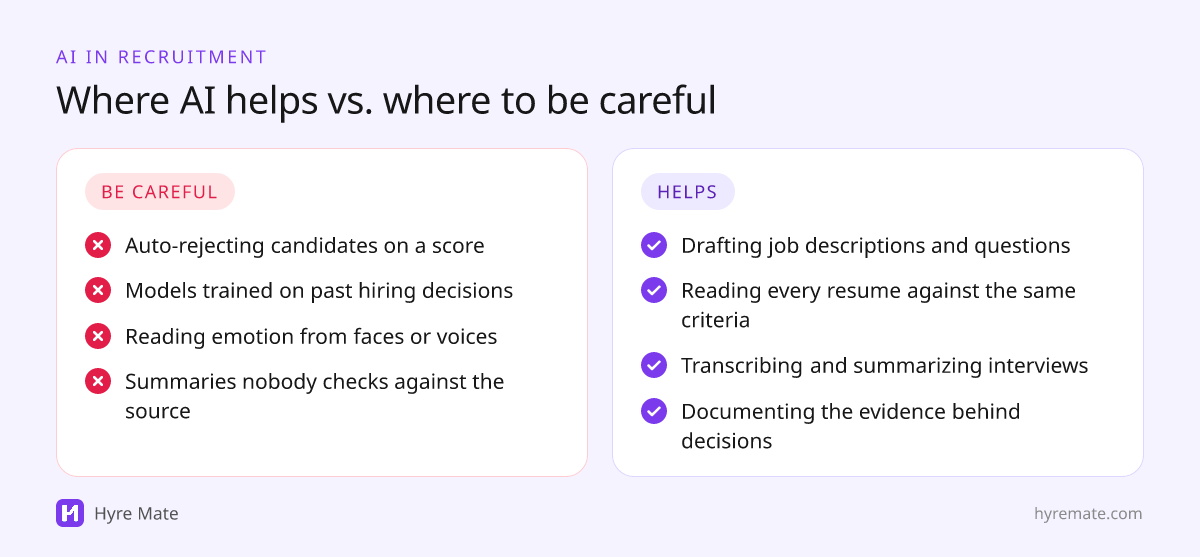
- AI is most useful for repetitive, text-heavy work: drafting, reading, transcribing and summarizing.
- Hiring decisions should stay with people. AI output is evidence to review, not a verdict.
- AI trained on past hiring data can repeat past bias, as Amazon found with an experimental résumé tool.
- New York City, Illinois and the EU already regulate parts of hiring AI, and more rules are coming.
- Tell candidates how AI is used, check outcomes for adverse impact and keep data only as long as needed.
What is AI in recruitment?
"AI in recruitment" covers a wide range of tools, from simple keyword filters to large language models that write, read and summarize. Today, most of the useful applications fall into two groups:
- Generative AI that produces text: job descriptions, interview questions, interview notes, candidate summaries and email drafts.
- Analytical AI that scores or classifies: matching resumes against a job, scoring interview answers, or flagging missing skills.
The distinction matters because the risks differ. A badly drafted job description is easy to spot and fix. A scoring model that quietly ranks some groups of people lower is not.
How is AI used across the hiring process?
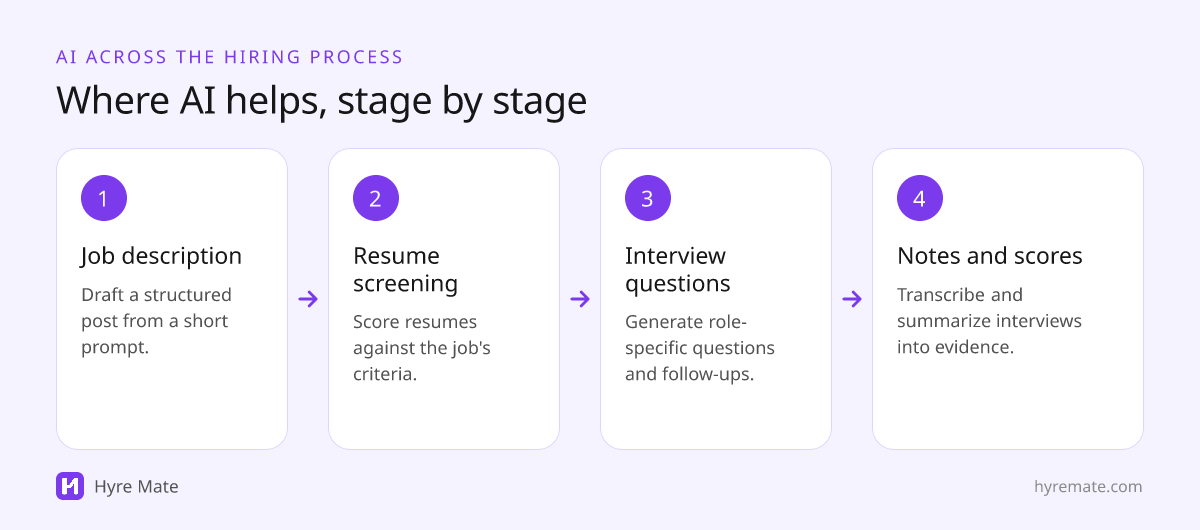
| Stage | What AI can do | What people should still do |
|---|---|---|
| Job description | Draft a structured description, responsibilities and requirements from a short prompt | Check accuracy, cut unnecessary requirements, approve |
| Resume screening | Parse resumes and score them against the job's criteria | Agree the criteria, review the evidence, decide who goes forward |
| Interview preparation | Generate role-specific questions and follow-ups | Choose the questions and agree scoring anchors |
| Interviews | Transcribe the conversation and summarize it into notes | Run the interview, get consent to record, listen |
| Evaluation | Score answers on consistent dimensions and list strengths and weaknesses | Check against the transcript, weigh the evidence, decide |
| Communication | Draft updates and feedback messages | Personalize, check tone and send |
What are the benefits of AI in recruitment?
- Time back on repetitive work. Reading hundreds of resumes, writing up interview notes and drafting job posts are where recruiters lose the most hours, and they're exactly what language models are good at.
- More consistent evaluations. A tool that scores every candidate on the same dimensions doesn't get tired at application 200 or warm to a candidate who shares its hobbies.
- Better documentation. Transcripts, notes and scores mean decisions are written down and can be checked later.
- A faster process for candidates. Quicker screening and write-ups mean shorter waits between stages, which strong candidates notice.
- More attention on people. When note-taking is handled, interviewers can actually listen.
What are the risks of using AI in hiring?
The benefits are real, but so are the failure modes. The best-known example is Amazon's experimental résumé-ranking tool: according to Reuters, the model learned from ten years of mostly male applications and began penalizing résumés associated with women. Amazon scrapped the project, and recruiters had never relied on its rankings alone. The lesson applies to any tool trained on past decisions.
- Bias at scale. A model can learn patterns from historical data that disadvantage groups of people, and then apply them to every applicant.
- Opacity. If you can't see why a candidate scored low, you can't check whether the reason is job-related.
- Automation bias. People tend to defer to a number on a screen, even when their own evidence points the other way.
- Inaccurate output. Generative AI can misstate what was said or invent details, so summaries need checking against the source.
- Privacy. Resumes and interview recordings are personal data, with legal limits on how they're used and kept.
- Contested science. Claims that software can read personality or emotion from faces or voices are scientifically contested, and the EU has banned emotion recognition in the workplace.
What laws apply to AI in hiring?
Regulation is moving quickly. A few rules employers commonly need to know about:
| Law | Where | What it requires |
|---|---|---|
| Local Law 144 | New York City | Independent bias audit of automated employment decision tools, a published summary, and notice to candidates at least 10 business days before use |
| AI Video Interview Act | Illinois | Notice, an explanation of how the AI works and consent before AI analyzes applicants' recorded video interviews; deletion on request |
| EU AI Act | European Union | Recruitment AI is high-risk, with obligations applying from December 2, 2027; emotion recognition at work banned since February 2025 |
| GDPR, Article 22 | EU and UK | Limits on significant decisions based solely on automated processing |
| Uniform Guidelines | United States | The four-fifths rule of thumb for spotting adverse impact in selection rates |
This is a summary, not legal advice. Our article on recording job interviews goes into more detail on consent and the AI-specific rules.
How do you use AI in recruitment responsibly?
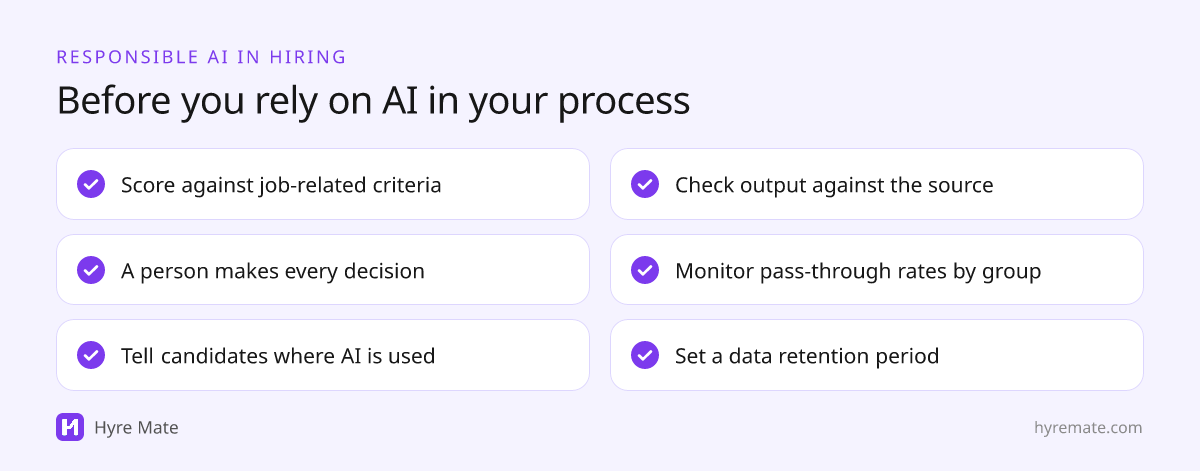
- Start with job-related criteria. AI should score candidates against criteria your team agreed, such as the role's skills and experience, not against a vague idea of a "good hire".
- Keep a person responsible for every decision. Treat scores and summaries as evidence to review. Don't auto-reject.
- Tell candidates. Say where AI is used, what it evaluates and how to ask for a human review or an alternative.
- Check output against the source. Read the transcript behind an AI summary, and the resume behind a score.
- Monitor outcomes. Compare pass-through rates by group at each stage, using the four-fifths rule as a first check.
- Minimize data. Collect what you need, set a retention period and delete on schedule.
- Skip emotion reading. Don't use tools that claim to read emotion, honesty or personality from faces or voices.
How should you introduce AI to your hiring team?
Rolling AI out to a whole hiring team at once tends to create confusion and distrust. A gradual approach works better:
- Start with one low-risk task, such as interview notes or job description drafts, where output is easy to check.
- Run it alongside your current process for a few weeks. Compare AI notes with interviewers' own notes, or AI resume scores with recruiters' judgments.
- Discuss the differences. Where the AI and people disagree, look at the evidence. Sometimes the AI missed context; sometimes it caught something people skipped.
- Write a short policy covering where AI is used, who reviews its output, what candidates are told and how long data is kept.
- Expand one stage at a time, and keep monitoring outcomes after each change.
What should you ask before choosing AI recruiting software?
- What exactly does the tool score, and can I see the evidence behind each score?
- Was it trained or tested for bias, and can you share the results?
- Does it record audio, video or both? Does a bot join my calls?
- Where is candidate data stored, who can access it and how do I delete it?
- Can candidates request a human review?
- Does it integrate with the tools we already use, such as our applicant tracking system?
Where does Hyre Mate fit?
Hyre Mate is AI recruitment software for the parts of hiring that involve the most reading and writing. It drafts job descriptions from a prompt, screens resumes in bulk with a 0 to 100 score and a breakdown of matched and missing skills, generates interview questions for ten interview types, and turns interview recordings and transcripts into AI notes, scores and a written assessment.
To be clear about the limits: recordings made in Hyre Mate are audio-only, and the analysis works from what was said, not from faces or tone of voice. It doesn't source candidates, and it doesn't currently integrate with applicant tracking systems. Scores are there to help you review faster and more consistently; the hiring decision, and telling candidates how you use AI, stay with you.
Frequently asked questions
Will AI replace recruiters?
Not the important parts. AI is good at drafting, reading and summarizing, but recruiting depends on judgment, relationships and persuasion. What's changing is how recruiters spend their time: less on admin and write-ups, more on candidates and hiring managers.
Is it legal to use AI in hiring?
Generally yes, but some places regulate it. New York City requires bias audits and candidate notice for automated employment decision tools, Illinois regulates AI analysis of video interviews, and the EU AI Act treats recruitment AI as high-risk. Anti-discrimination laws apply whether a decision is made by a person or software.
Can AI reduce bias in hiring?
It can make evaluations more consistent, because every candidate is scored on the same criteria. But AI can also learn bias from historical data, so it only helps when the criteria are job-related, people review the results and you monitor outcomes by group.
Which recruiting tasks should you automate first?
Start with tasks where AI output is easy to check: drafting job descriptions, transcribing and summarizing interviews, and generating question banks. Move on to resume scoring once your criteria are clear and you have a process for reviewing scores.
Should you tell candidates you use AI?
Yes. Some laws require it, and it builds trust. Explain where AI is used, what it evaluates, and how candidates can ask questions or request a human review.
What's the difference between an ATS and AI recruiting software?
An applicant tracking system (ATS) manages job postings, applications and pipeline stages. AI recruiting software focuses on analysis and content, such as scoring resumes, generating questions and summarizing interviews. Some products combine both; others, like Hyre Mate, focus on the AI work.
Sources
- Reuters via Euronews: Amazon scraps secret AI recruiting tool that showed bias against women (2018)
- Holistic AI: NYC bias audit law (Local Law 144)
- SHRM: Illinois employers must comply with the Artificial Intelligence Video Interview Act
- artificialintelligenceact.eu: Digital Omnibus on AI
- Bird & Bird: Navigating prohibited AI practices in the workplace
- 29 CFR 1607.4: Information on impact (Uniform Guidelines)