Is it legal to record a job interview? Consent rules for recruiters
When you can record an interview, which US states require everyone's consent, how AI hiring laws in Illinois, NYC and the EU apply, and how to ask for consent.
By the Hyre Mate team
Quick answer
In most places, yes, as long as you have the right consent. US federal law and most states allow recording when at least one person in the conversation consents, but several states, including California, Florida, Illinois, Maryland, Massachusetts, Pennsylvania and Washington, require everyone's consent. Using AI to analyze interviews can add further rules. The safe approach everywhere is to tell candidates in advance, get their explicit consent and keep a record of it.
Key takeaways
- US federal law requires one party's consent, but a group of states require everyone on the call to agree.
- When people are in different states, plan for the strictest rule that could apply.
- AI analysis of interviews has its own rules in places such as Illinois, New York City and the EU.
- In the EU, UK and India, data protection law requires clear notice, a lawful basis and limited retention.
- Announce the recording in the invitation, confirm consent on the recording itself and set a retention period.
This article is general information, not legal advice. Laws change and differ by location, so check with a qualified lawyer before setting your recording policy. Last reviewed October 2026.
Can you legally record a job interview?
Recording interviews gives interviewers an accurate record and makes AI interview notes possible. But recording a conversation is regulated almost everywhere, and job interviews add another layer: you're collecting personal data about someone applying to work for you.
There are three sets of rules to think about:
- Recording and wiretap laws, which decide whose consent you need to record a conversation at all.
- AI-specific hiring laws, which add notice and consent duties when software analyzes an interview.
- Data protection laws, which govern how you collect, use, store and delete the recording.
What is the difference between one-party and all-party consent?
US recording laws fall into two broad groups:
- One-party consent: a conversation can be recorded if at least one participant consents. If you're in the conversation, your own consent is enough. Federal law follows this rule, as do most states.
- All-party (or two-party) consent: everyone in the conversation must consent before it's recorded.
So recording a candidate without telling them might be legal in one state and illegal in another, and you rarely control where the candidate is sitting.
Which US states require all-party consent?
State laws differ in their details, and courts don't always read them the same way, but these states are commonly listed as requiring the consent of everyone in the conversation:
| Group | States | What it means for interviews |
|---|---|---|
| All-party consent | California, Florida, Illinois, Maryland, Massachusetts, Pennsylvania, Washington | Get consent from everyone on the call before recording |
| Often listed as all-party, with nuances | Montana, New Hampshire, Oregon | Treat as all-party consent |
| All-party consent for phone calls | Connecticut, Nevada | Get consent before recording phone or video calls |
| One-party consent | Most other states, and federal law | Your consent as a participant is legally enough, but tell candidates anyway |
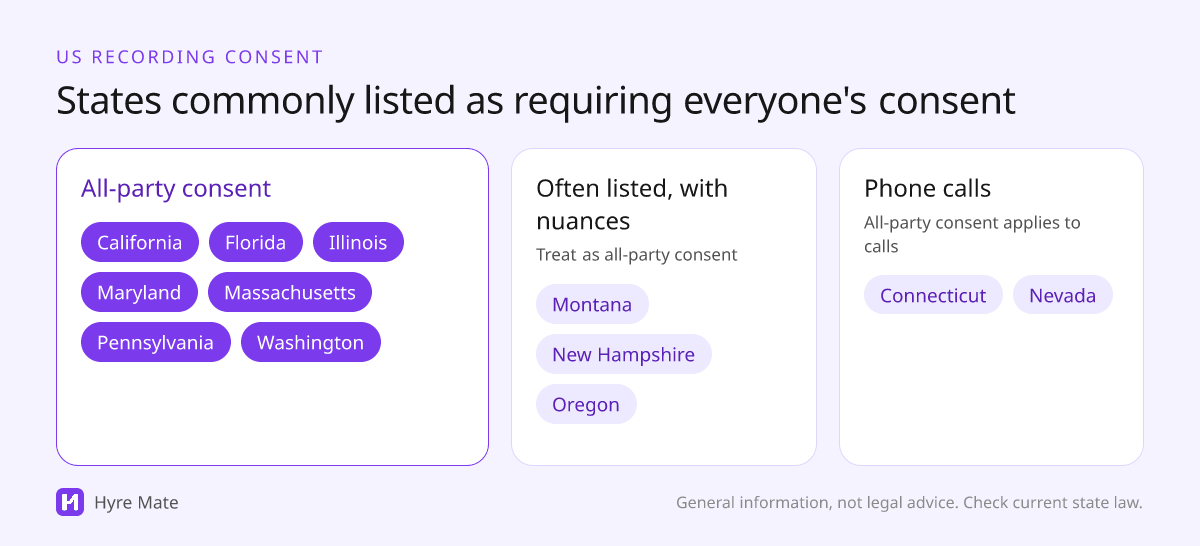
When a call crosses state lines, say a recruiter in Texas and a candidate in California, assume the stricter law applies. Penalties can include criminal charges and civil damages, so plan for all-party consent on every interview.
Does using AI to analyze interviews change the rules?
Yes, in some places. Recording law asks whether you may capture the conversation; AI laws ask what you must tell candidates when software evaluates it. Three examples employers commonly run into:
Illinois: the Artificial Intelligence Video Interview Act
Illinois's Artificial Intelligence Video Interview Act (820 ILCS 42), in force since January 1, 2020, applies when an employer asks applicants to record video interviews and uses AI to analyze them, for positions based in Illinois. Before the interview, the employer must:
- Tell the applicant that AI may be used to analyze their video interview
- Explain how the AI works and what general types of characteristics it uses to evaluate applicants
- Get the applicant's consent to be evaluated by the AI
Videos may be shared only with people needed to evaluate the applicant, and must be deleted, including copies, within 30 days of an applicant's request. Even where a live interview isn't strictly covered, it's a sensible model to follow.
New York City: Local Law 144
New York City's Local Law 144 regulates automated employment decision tools: software that produces a score, classification or recommendation used to substantially assist or replace discretionary hiring or promotion decisions. Since enforcement began on July 5, 2023, employers using such a tool for candidates who live in the city must have it bias-audited by an independent auditor within the past year, publish a summary of the audit, and notify candidates at least ten business days before the tool is used.
Whether a tool counts depends on how you use it: notes an interviewer reads before deciding are different from a score that automatically screens candidates out. If you hire in New York City, get advice on where your process falls.
European Union: the AI Act
The EU AI Act classifies AI systems used in recruitment and selection, for example to filter applications or evaluate candidates, as high-risk. Providers and the employers using them face obligations including human oversight, transparency and record-keeping. These were due to apply from August 2, 2026, but 2026 amendments known as the Digital Omnibus on AI moved the date for this category to December 2, 2027.
Some parts already apply. Since February 2025 the Act has banned AI that infers people's emotions in the workplace, and the European Commission's guidelines indicate this covers job candidates too. Don't use tools that claim to read candidates' emotions from their face or voice in the EU.
What do data protection laws require?
Wherever you hire, an interview recording is personal data, and so are the transcript, notes and scores derived from it. Data protection laws don't usually ban recording, but they control how you do it.
GDPR (EU) and UK GDPR
- Lawful basis: employers often rely on legitimate interests or consent. Regulators are skeptical that an applicant's consent is always freely given, so document your reasoning.
- Transparency: before the interview, tell candidates what you record, why, who sees it and for how long.
- Retention: keep recordings only as long as you need them.
- Candidate rights: candidates can request their recordings, transcripts and notes, and can often ask for deletion.
- Automated decisions: Article 22 limits significant decisions based solely on automated processing, so keep a person responsible for the hiring decision.
India: the DPDP Act and Rules
India's Digital Personal Data Protection Act, 2023 is being brought into force through the DPDP Rules, 2025, notified in November 2025. Most core duties, including detailed notice and consent requirements, apply about 18 months after notification, around May 2027, so build clear notice and consent into interview invitations now.
| Region | Key rules | What to do |
|---|---|---|
| United States | State recording laws (one-party or all-party); Illinois AI Video Interview Act; NYC Local Law 144 | Get everyone's consent; give AI notices where required; check state and city rules |
| EU and UK | GDPR and UK GDPR; EU AI Act (recruitment AI is high-risk) | Lawful basis, privacy notice, retention limits, human oversight |
| India | DPDP Act 2023 and DPDP Rules 2025 (phased in) | Clear notice and consent; prepare for the main obligations from 2027 |
How do you ask a candidate for consent to record?
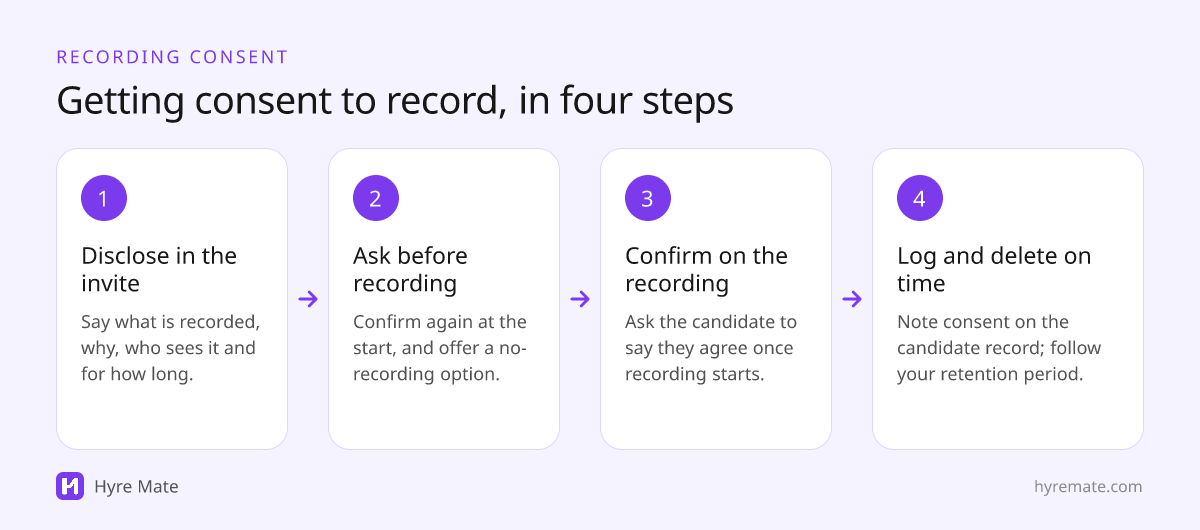
Consent works best in two steps: in writing before the interview, and verbally at the start of the recording.
- In the invitation, say the interview will be recorded, why, who will see it and how long you'll keep it, and link to your privacy notice.
- At the start of the call, ask again before you press record, then ask the candidate to confirm on the recording.
- Offer an alternative. If a candidate says no, take notes manually instead, and don't hold it against them.
- Log the consent on the candidate's record, with the date.
Sample consent script
"Before we start: with your permission, I'd like to record this interview. We use the recording to produce accurate notes and an AI-generated summary for the hiring team. Only people involved in this hiring decision will see it, and we delete it after [retention period]. You're welcome to say no, and it won't affect your application. Are you happy for me to record?"
[Start recording] "For the record, could you confirm you're okay with this interview being recorded?"
Can a candidate record the interview?
Candidates are subject to the same laws. In a one-party consent state, a candidate may be able to record legally without telling you; in an all-party state, they can't. Either way, conduct every interview as though it might be heard later.
How long should you keep interview recordings?
Long enough to make and defend the decision, and no longer. Two reference points:
- US federal recordkeeping: the EEOC requires private employers to keep hiring records for at least one year from when the record was made or the decision was taken, whichever is later, and longer if a discrimination charge is filed (29 CFR 1602.14).
- Data protection: under laws such as the GDPR, you should keep personal data only as long as necessary for its purpose, and say how long that is in your privacy notice.
Many employers keep the summary, scores and notes for the retention period and delete the raw audio sooner. Whatever you choose, write it down and apply it consistently.
Interview recording compliance checklist
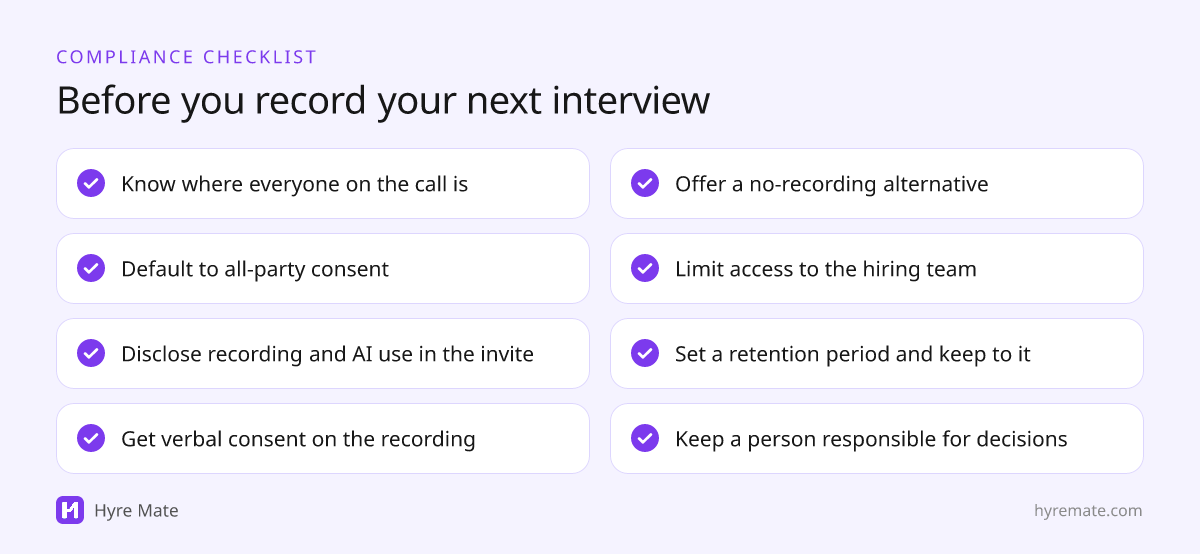
- Know where your interviewers and candidates are located
- Default to all-party consent for every interview
- Disclose the recording and any AI analysis in the invitation
- Get verbal consent again at the start of the recording
- Offer a no-recording alternative without penalty
- Limit access to people involved in the hiring decision
- Set and document a retention period, then delete on schedule
- Keep a person responsible for every hiring decision
How does Hyre Mate handle interview recording?
Hyre Mate only records when you start a recording yourself, in your browser. You choose your microphone or a browser tab with a video call, and your browser asks you to grant access before anything is captured. No bot joins the meeting, so the candidate won't see an extra participant, which is exactly why you should tell them yourself.
Recordings are uploaded over HTTPS and processed into a transcript, AI notes and scores, and you can delete interviews, candidates and jobs. Hyre Mate doesn't collect consent from candidates on your behalf: that's your responsibility as the employer. See our security page and privacy policy for details.
Frequently asked questions
Is it illegal to record a job interview without consent?
It can be. In US states with all-party consent laws, such as California, Florida and Illinois, recording a conversation without everyone's consent can be a crime and can lead to civil claims. Even where one-party consent applies, recording candidates secretly damages trust and can conflict with data protection laws elsewhere.
Do I need consent to use AI notes in interviews?
If the tool records the conversation, recording consent rules apply, and some places add AI-specific duties, such as Illinois's AI Video Interview Act and New York City's Local Law 144. Telling candidates about AI use and asking for consent is the safest approach everywhere.
Is California a two-party consent state?
Yes. California requires the consent of all parties to record a confidential conversation, including phone and video calls. If either the interviewer or the candidate is in California, get everyone's consent before recording.
What happens if a candidate refuses to be recorded?
Run the interview without recording and take notes manually. Refusing shouldn't count against the candidate. In the EU and UK in particular, consent that comes with a penalty for saying no isn't freely given.
Are AI interview tools high-risk under the EU AI Act?
AI systems used to recruit or select people, such as tools that filter applications or evaluate candidates, are classified as high-risk under the EU AI Act. After the 2026 Digital Omnibus amendments, the main high-risk obligations apply from December 2, 2027.
Sources
- Kilpatrick Townsend: Wiretap laws in the United States
- Reporters Committee for Freedom of the Press: Reporter's recording guide
- SHRM: Illinois employers must comply with the Artificial Intelligence Video Interview Act
- Holistic AI: NYC bias audit law (Local Law 144)
- artificialintelligenceact.eu: Digital Omnibus on AI
- Gibson Dunn: EU AI Act Omnibus agreement and postponed high-risk deadlines
- Bird & Bird: Navigating prohibited AI practices in the workplace
- PIB: Digital Personal Data Protection Rules, 2025
- 29 CFR 1602.14: Preservation of records made or kept (eCFR)