How to take interview notes: a recruiter's guide (with template)
How to take interview notes that capture evidence, not impressions: what to write down, what to leave out, a copy-ready template and where AI note-takers fit.
By the Hyre Mate team
Quick answer
To take good interview notes, prepare a template built around the role's criteria before the call. During the interview, write down evidence (what the candidate actually said and did, in their words) rather than impressions, and use shorthand so you keep listening. Then turn your notes into a summary and scores within minutes of the interview ending. If the candidate consents, a recording or transcript gives you an accurate backup.
Key takeaways
- Notes are evidence for a hiring decision, so record what the candidate said and did, not how they made you feel.
- A template tied to your scorecard tells you what to listen for and keeps notes comparable across candidates.
- Write up your summary and scores independently, before you talk to other interviewers.
- Never note protected characteristics such as age, religion, family plans or health.
- AI note-takers can capture the transcript and a first draft of notes, but the judgment stays with you.
Why do interview notes matter?
Interviews generate a lot of information in a short time, and memory is a poor place to store it. By the time a hiring panel meets, an interviewer who saw four candidates that week is often working from a blurred impression of who seemed strongest. Notes fix that. They turn a conversation into a record you can come back to, compare and share.
Good notes do four jobs at once:
- They make comparisons fair. When every candidate is assessed against the same criteria and the evidence is written down, you compare answers, not memories.
- They make debriefs faster. Instead of arguing over impressions, the panel can look at what each person actually heard.
- They help the next interviewer. Gaps or concerns from one round can be probed properly in the next, rather than rediscovered.
- They document the decision. If a hiring decision is ever questioned, job-related notes show what it was based on. In the US, for example, the EEOC requires private employers to keep hiring records for at least a year (29 CFR 1602.14).
What should you write down during an interview?
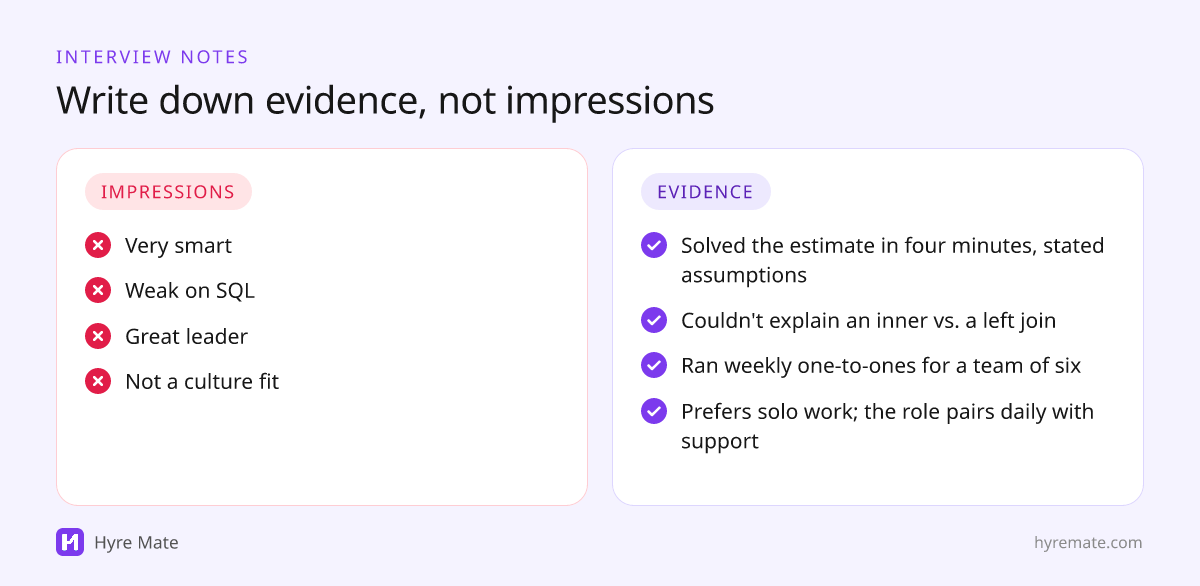
The most useful rule is simple: write down evidence, not conclusions. "Great communicator" is a conclusion. "Explained the database migration without jargon, then adjusted when I asked about rollback" is evidence. Conclusions are what you decide later; evidence is what you need to decide well.
For each question, try to capture:
- The situation and the candidate's role in it. What was the context, and what did they personally own versus what the team did?
- Specific actions. The steps they took, the tools they used and the decisions they made.
- Results and numbers. Outcomes, scale, timelines and metrics, exactly as the candidate stated them.
- Direct quotes for anything striking, good or bad, in quotation marks so you know they are verbatim.
- Follow-ups you didn't get to, and any claims you want to check in a later round.
This mirrors the STAR structure (situation, task, action, result) behind many behavioral questions, so it's easy to spot an answer that's missing a piece.
| Instead of writing… | Write the evidence |
|---|---|
| Very smart | Solved the pricing estimate in about four minutes; stated assumptions out loud and sanity-checked the result |
| Weak on SQL | Couldn't explain the difference between an inner join and a left join when asked twice |
| Great leader | Ran weekly one-to-ones for a team of six; described moving an underperformer to a better-fit project |
| Not a culture fit | Said they prefer working alone for long stretches; the role pairs daily with the support team |
| Seemed nervous | Leave it out unless it is genuinely relevant to the job |
What should you never write in interview notes?
Anything that isn't related to the job doesn't belong in your notes, and some things create real legal risk if they appear there. Avoid writing down or commenting on:
- Age, race, ethnicity, religion, nationality, gender, sexual orientation or disability
- Marital status, pregnancy, children or family plans
- Health, medical history or appearance
- Accent or manner of speaking, unless spoken communication in a particular language is a genuine job requirement
- Personal guesses, jokes or nicknames for candidates
If a candidate volunteers personal information, don't record it, and imagine the candidate reading your notes. In many places that isn't hypothetical: under data protection laws such as the GDPR, candidates can ask for a copy of the personal data an employer holds about them, which can include interview notes.
How do you take notes and still listen?
Note-taking competes with listening, and candidates notice when an interviewer is typing more than paying attention. A few habits help:
- Tell the candidate up front. A simple "I'll be taking notes so I can represent your answers accurately" makes pauses feel normal.
- Prepare your template before the call. Pre-fill the questions and criteria so you only write answers, not structure.
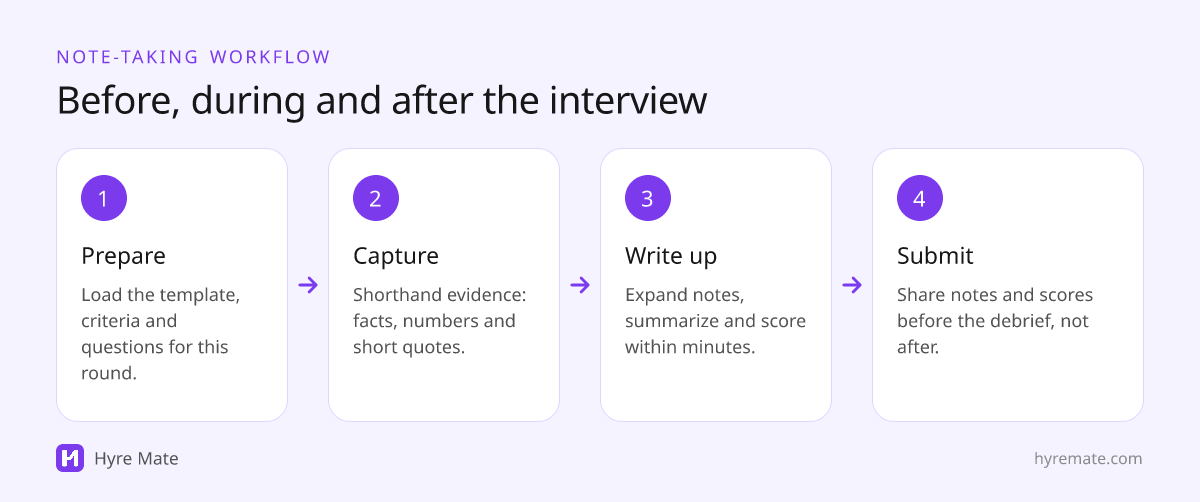
- Use shorthand. Keywords, numbers and short quotes during the interview; full sentences afterwards.
- Pause between questions. Two or three seconds to finish a note is fine, and it gives the candidate a breath too.
- Split roles in panel interviews. One person leads the questions while another focuses on notes, then swap for the next candidate.
Interview notes template you can copy
A template keeps notes consistent across interviewers and makes it obvious when something wasn't covered. Adapt the criteria to the role, but keep the structure identical for every candidate in the same round.
Interview notes template
Candidate · Role · Round · Interviewer · Date
Criteria for this round: the three to five competencies you are responsible for
Q1: [question] · Evidence: … · Follow-up: …
Q2: [question] · Evidence: … · Follow-up: …
Q3: [question] · Evidence: … · Follow-up: …
Strengths seen, with evidence: …
Concerns or gaps, with evidence: …
Questions the candidate asked: …
To probe in the next round: …
Score per criterion (1–5) and overall recommendation: …
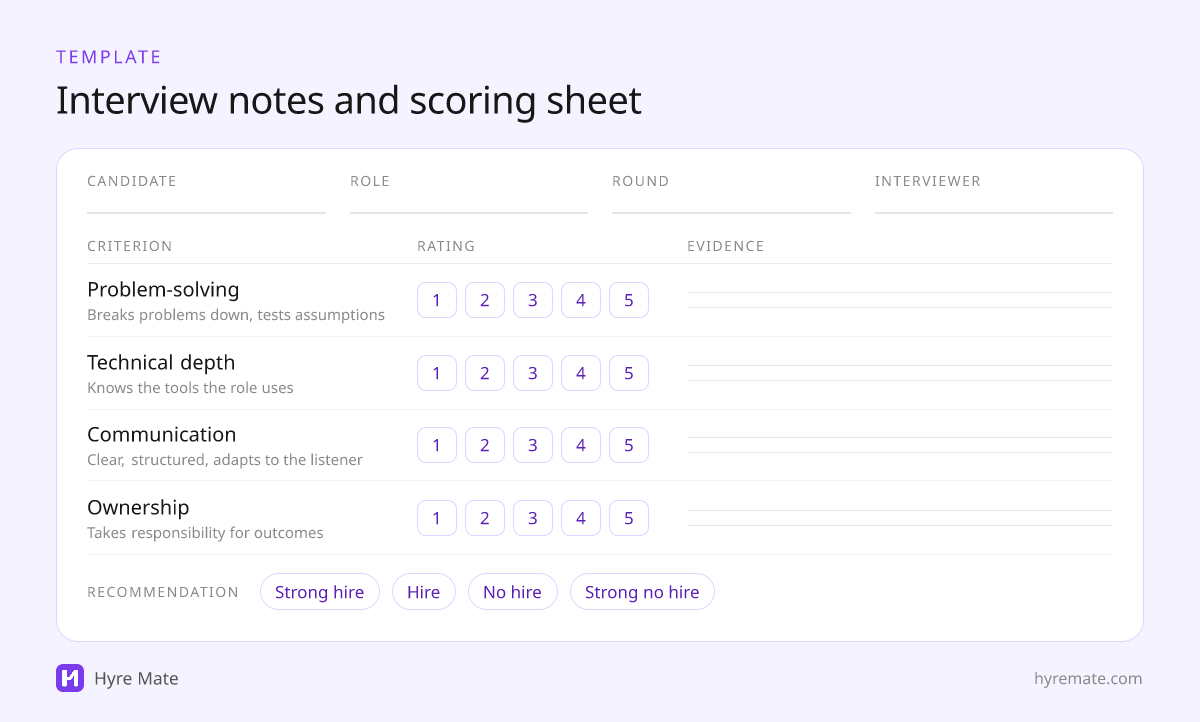
To go further, our guide to building an interview scorecard shows how to write rating anchors for each criterion, so that a "4" means the same thing to every interviewer.
What should you do right after the interview?
The minutes right after an interview decide whether your notes stay useful. Block ten to fifteen minutes in your calendar after every interview and use them to:
- Expand your shorthand into readable sentences while you still remember the context.
- Write a two- or three-sentence summary: the main strengths, the main concerns and your recommendation.
- Score each criterion against your rubric, citing the evidence behind each score.
- List open questions for the next interviewer.
- Submit your notes and scores before you talk to anyone else on the panel.
That last step matters. If interviewers discuss a candidate before writing up their own view, the first or most senior opinion tends to anchor everyone else. Independent write-ups keep each interviewer's evidence intact for the debrief. For the write-up itself, see how to write interview feedback.
Should you record interviews instead of taking notes?
Recording solves the accuracy problem: you have every word and can quote the candidate exactly, and you're free to follow the conversation rather than chase it with a pen. The trade-offs are consent, storage and review time.
| Method | Accuracy | Attention on the candidate | Effort afterwards | Main watch-out |
|---|---|---|---|---|
| Handwritten notes | Partial | Medium | High: must be typed up | Hard to share and search |
| Typed notes | Partial | Lower: typing can distract | Medium | Notes favor what was easy to type |
| Recording only | Complete | High | High: hours of audio to review | Needs consent; hard to skim |
| Recording with AI notes | Complete, plus a summary | High | Low: review and edit the notes | Needs consent; check the AI's output |
Before you record anything, check the consent rules where you and the candidate are. Several US states require everyone on a call to agree to a recording, and AI analysis of interviews has its own rules in some places. Our guide to whether it's legal to record a job interview covers the details.
How do AI interview note-takers work?
An AI interview note-taker records or receives the conversation, transcribes it and summarizes it into notes, often with an assessment. Most tools work in one of two ways: a bot joins your video call as an extra participant, or the recording happens on your side, in your browser or app.
Hyre Mate's AI interview note-taker works the second way. You select a scheduled interview, then record from your microphone for in-person or phone interviews, or capture the audio of a video call you have open in a browser tab, so no bot joins the meeting. When you stop recording, the audio is uploaded and processed, and you get:
- AI notes in markdown, organized so you can scan them quickly
- A speaker-labeled transcript to check exactly what was said
- Scores from 0 to 100 for technical skills, communication, problem-solving and cultural fit, plus an overall score
- A written assessment with a summary, a recommendation, next steps, and strengths and weaknesses for each dimension
You can also upload a recording you already have (WAV, MP3, MP4, AAC, OGG or WebM, up to 50 MB) or paste in a transcript. Processing happens after the interview rather than live, so the notes are ready to review once the upload is processed.
Treat the AI's output as a first draft of your notes, not as the decision. Read the summary against the transcript, add context a recording can't capture and make the hiring call yourself.
What are the most common note-taking mistakes?
- Writing verdicts instead of evidence. "Strong" or "weak" with nothing behind it can't be compared or defended.
- Inconsistent notes across candidates. Detailed notes on the first candidate and three lines on the fifth make the fifth look weaker than they were.
- Waiting until the end of the day. By then, details from different interviews blend together.
- Copying the job description back. "Has Python experience" tells the panel nothing. What did they build with it?
- Recording personal details. Anything unrelated to the job is a liability, not context.
Frequently asked questions
Is it okay to take notes during a job interview?
Yes. Interviewers are expected to take notes, and most candidates see it as a sign you're taking their answers seriously. Mention at the start that you'll be taking notes, keep eye contact between notes and pause briefly if you need to finish a thought.
How detailed should interview notes be?
Detailed enough that another interviewer could understand why you scored the candidate the way you did. In practice that's a few lines of evidence per question (key facts, numbers and short quotes) plus a short summary and your scores.
How long should you keep interview notes?
It depends on where you hire. In the US, private employers covered by the EEOC's rules must keep hiring records for at least one year, and longer if a discrimination charge is filed. Data protection laws such as the GDPR also expect you not to keep personal data longer than necessary, so set a written retention period and stick to it.
Can candidates ask to see interview notes?
In some places, yes. Under data protection laws such as the GDPR, candidates can request a copy of the personal data an employer holds about them, which can include interview notes. Write every note as if the candidate might read it.
Can AI take interview notes for me?
Yes. AI note-takers transcribe the conversation and summarize it into notes, and some, like Hyre Mate, also score the interview. Get the candidate's consent before recording, and review the AI's notes before relying on them.
Should I take interview notes on paper or a laptop?
Either works. Laptops are faster and easier to share; paper is quieter and can feel more personal. What matters more is using the same template for every candidate and writing up your notes the same day.