How to write interview feedback (with examples and templates)
How to write clear, evidence-based interview feedback for your hiring team and for candidates, with examples for hire, no-hire and on-hold decisions.
By the Hyre Mate team
Quick answer
Good interview feedback is specific, evidence-based and tied to the criteria the role was assessed on. For your hiring team, lead with a clear recommendation, then give the evidence for and against each competency you assessed. For candidates, keep it short, kind and job-related: mention one or two genuine strengths and one or two areas where they fell short of what the role needs, without comparing them to other applicants.
Key takeaways
- Internal feedback and candidate feedback have different audiences and purposes, so write them separately.
- Start internal feedback with your recommendation, then back it up with evidence for each competency.
- Replace vague labels like "not a culture fit" with the specific, job-related behavior you observed.
- Candidate feedback should be brief, honest and about the job, never about personal characteristics.
- Write feedback the same day, before discussing the candidate with other interviewers.
What is interview feedback?
Interview feedback is the written assessment produced after an interview. The phrase covers two quite different things:
| Internal feedback | Candidate feedback | |
|---|---|---|
| Audience | Hiring manager and interview panel | The candidate |
| Purpose | Make and document a hiring decision | Explain the outcome and help the candidate improve |
| Detail | Detailed, competency by competency | Brief: a few sentences |
| Tone | Neutral and evidence-based | Respectful and constructive |
| Includes scores? | Yes | Usually not |
The two should be consistent (candidate feedback should never contradict the reasons recorded internally), but they're written differently. This guide covers both.
How do you write interview feedback for the hiring team?
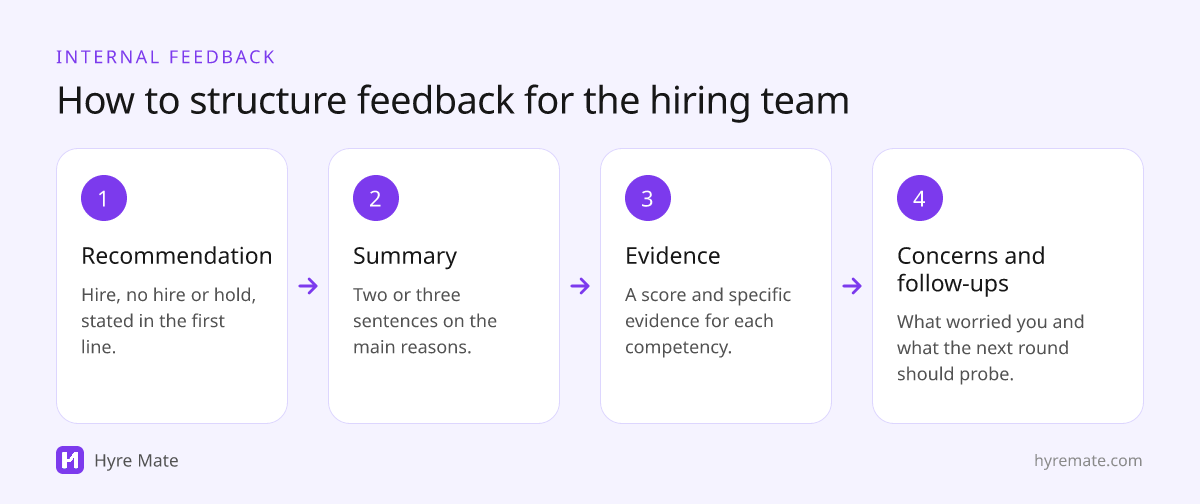
Internal feedback is a decision document. Someone who wasn't in the room should be able to read it and understand what you saw and why you recommend what you do. A reliable structure:
- Recommendation first. Strong hire, hire, no hire or strong no hire, or advance, hold or reject. Don't bury it at the end.
- A two- or three-sentence summary. The main reasons for your recommendation.
- Evidence per competency. For each competency your round assessed, the score and the specific evidence behind it.
- Concerns. Anything that worried you, with evidence, and whether it's a dealbreaker.
- Follow-ups for the next round. What you didn't get to, or what another interviewer should probe.
Base the evidence on your interview notes, and score against the anchors in your interview scorecard so your ratings mean the same thing as everyone else's.
Interview feedback examples for the hiring team
Here are three examples for a customer success manager role, one for each common outcome.
Example: hire
Recommendation: Hire.
Summary: Strong on customer communication and renewal strategy. Some gaps in data analysis that look coachable.
Communication (4/5): Walked through a difficult renewal call step by step, including how they reframed a price objection around the customer's usage data.
Account strategy (4/5): Described a quarterly business review template they built that their team of eight adopted.
Data analysis (2/5): Could name the metrics they track but not how they'd investigate a drop in product usage.
Follow-up: The next round should test how they work with churn data in a spreadsheet exercise.
Example: no hire
Recommendation: No hire.
Summary: Friendly and articulate, but couldn't show evidence of owning renewals, which is the core of this role.
Account ownership (1/5): Both renewal examples were led by their manager. When asked about their own role, they described preparing slides.
Communication (3/5): Clear, well-structured answers; checked for understanding.
Concern: The role owns a book of around 40 accounts from week one. Nothing in the interview suggested readiness for that.
Example: on hold
Recommendation: On hold. A strong candidate, but the timing doesn't fit.
Summary: Met the bar on every competency we assessed, but isn't available for four months and we need someone within six weeks.
Next step: Keep in touch for the next opening and reconnect next quarter.
What words should you avoid in interview feedback?
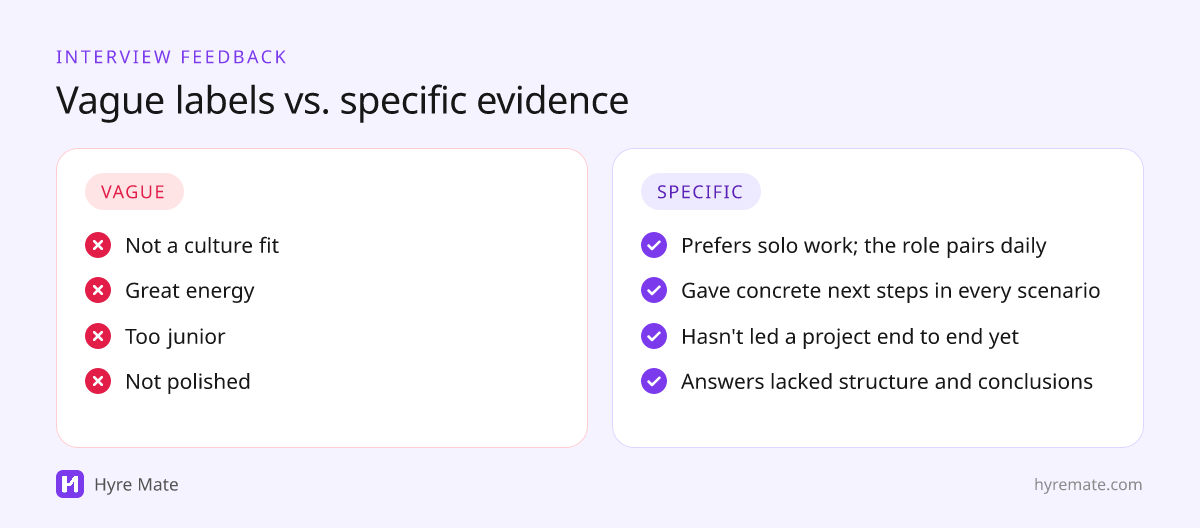
Vague or loaded language makes feedback hard to act on and can create legal risk. Some common phrases, and better alternatives:
| Avoid | Why | Write instead |
|---|---|---|
| Not a culture fit | Vague, and can mask bias | Prefers fully independent work; the role involves daily pairing with support |
| Great energy | Describes personality, not performance | Gave concrete next steps for every scenario question |
| Too junior / too senior | Can read as a proxy for age | Hasn't yet led a project end to end, which the role requires |
| Aggressive | Subjective, and often applied unevenly | Interrupted twice when asked to clarify their estimate |
| Not polished | Unclear, and close to commenting on appearance | Answers lacked structure and jumped between examples without a conclusion |
| Overqualified | Often a cover for another concern | Wants to manage a team; this is an individual contributor role |
And never mention protected characteristics such as age, gender, race, religion, disability, pregnancy or family status, not even as a positive.
Should you give feedback to rejected candidates?
Many candidates ask for feedback, and even a brief, specific note tends to leave a better impression of your company than a generic rejection. There are good reasons to give it:
- It respects the time the candidate invested, especially after later rounds.
- It protects your employer brand, because rejected candidates talk to other potential candidates.
- It helps strong "not yet" candidates come back better prepared.
The common worry is legal risk. That risk mostly comes from vague or inconsistent feedback, or feedback that touches on personal characteristics, which is why the discipline that makes internal feedback good also makes candidate feedback safer. A reasonable policy: a short personal note after a screening call, and more specific feedback for candidates who reached the final rounds.
How do you write feedback for a candidate?
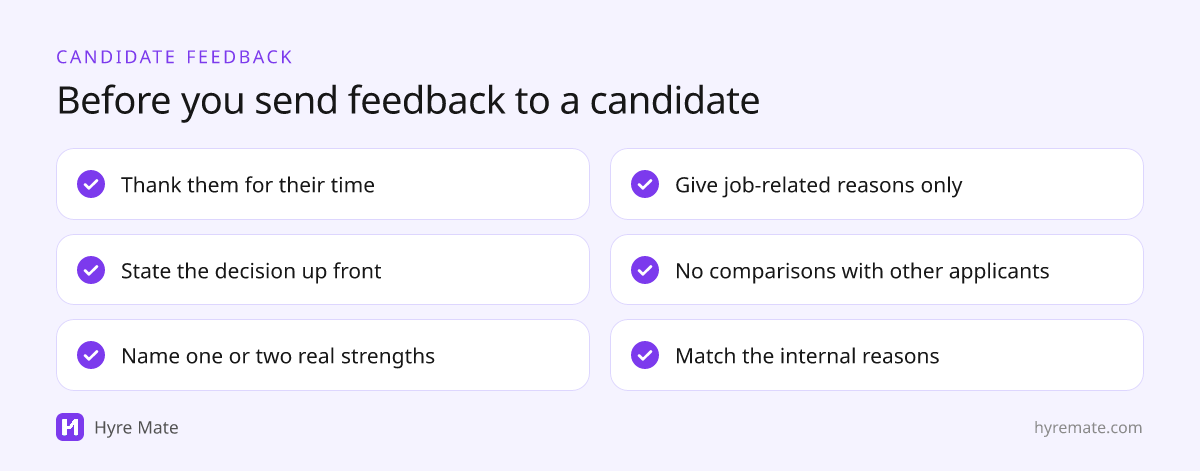
- Thank them for their time and interest.
- Give the decision clearly in the first lines. Don't make them hunt for it.
- Share one or two genuine strengths you saw.
- Share one or two job-related reasons they weren't selected, framed around what the role needs.
- Don't compare them to other candidates or reveal anything about other applicants.
- Stay consistent with the internal reasons for the decision.
- Close kindly, and invite them to apply again if you mean it.
Example: after a final round
Hi Sam, thank you for the time you spent with the team over the past two weeks.
We've decided not to move forward with your application for the Customer Success Manager role. It was a close decision.
The panel was impressed by how you handled the renewal role-play, especially how you reframed the pricing conversation around the customer's goals. Where we needed more was data analysis: the role involves investigating usage trends independently, and that's an area where we'd want to see more depth.
We'd be glad to hear from you about future roles. Thank you again, and best of luck.
Example: after a screening call
Hi Priya, thanks for speaking with me on Tuesday. We've decided to move forward with candidates whose experience is closer to the enterprise sales cycle this role focuses on. I enjoyed hearing about your work building the partner program, and I'd encourage you to apply for future roles on our partnerships team.
When should interview feedback be written and shared?
Write internal feedback the same day, ideally in the minutes right after the interview, and submit it before you discuss the candidate with anyone else. Waiting even a day lets memory fill gaps with impressions, and talking to colleagues first nudges your view towards theirs.
Send candidate feedback as soon after the decision as you can. A prompt, short and honest message is more useful to a candidate than a detailed one weeks later.
How can AI help you write interview feedback?
The slowest part of writing feedback is reconstructing what was said. If you record interviews (with consent), AI can do that work. In Hyre Mate, each analyzed interview produces a written assessment with a summary, a recommendation and next steps; strengths and weaknesses for technical skills, communication, problem-solving and cultural fit; and scores from 0 to 100, plus AI notes and a speaker-labeled transcript.
Use that output as raw material. Check the AI's summary against the transcript, pull exact quotes as evidence, add your own judgment on the competencies your team defined, and write the recommendation yourself. When the panel decides, mark the candidate as selected, on hold or rejected so the whole team can see the outcome. There's an example of the output on our AI interview note-taker page.
Frequently asked questions
What should I write in interview feedback?
Start with your recommendation, then a short summary of why. For each competency you assessed, give a score and the specific evidence behind it: what the candidate said or did. Finish with any concerns and questions for the next interviewer.
How long should interview feedback be?
Internal feedback is usually a short summary plus a few lines of evidence per competency, enough for someone who wasn't there to understand your reasoning. Candidate feedback should be shorter: a few sentences covering the decision, a strength and the main gap.
Should you give feedback to rejected candidates?
Generally yes, as long as it's brief, honest and job-related. Avoid comparisons with other candidates and anything related to personal characteristics, and make sure what you tell the candidate matches the reasons recorded internally.
How do you give positive interview feedback?
Be specific. Instead of "great interview", point to what the candidate did well and why it matters for the role, such as "your walkthrough of the migration plan showed exactly the kind of risk thinking this role needs."
What does "on hold" mean after an interview?
It usually means the team hasn't made a final decision: the candidate may be strong, but timing, budget or other candidates are still being considered. If you put a candidate on hold, tell them and give a realistic date for an update.
Can AI write interview feedback?
AI can draft it. Tools like Hyre Mate turn an interview recording or transcript into a summary, scores, and strengths and weaknesses. A person should still review the draft against the transcript and make the recommendation, especially for feedback sent to candidates.