Interview scorecard template: how to build one (with examples)
What an interview scorecard is, what to include, how to write rating anchors, plus a copy-ready template and examples for technical and non-technical roles.
By the Hyre Mate team
Quick answer
An interview scorecard is a form every interviewer uses to rate a candidate against the same job-related criteria, on the same rating scale, with space for the evidence behind each rating and an overall hire or no-hire recommendation. To build one, pick four to six competencies the role genuinely needs, describe what each score level looks like, assign each competency to a specific interview round, and have interviewers score independently before the debrief.
Key takeaways
- Score four to six job-related competencies per round, not everything you can think of.
- Write a short description (an anchor) for each score so a 4 means the same thing to every interviewer.
- Give every competency an owner: one round and one interviewer responsible for assessing it.
- Require evidence for every rating, and lock scores in before the debrief.
- Use the scorecard to structure the decision, not to replace it with an average.
What is an interview scorecard?
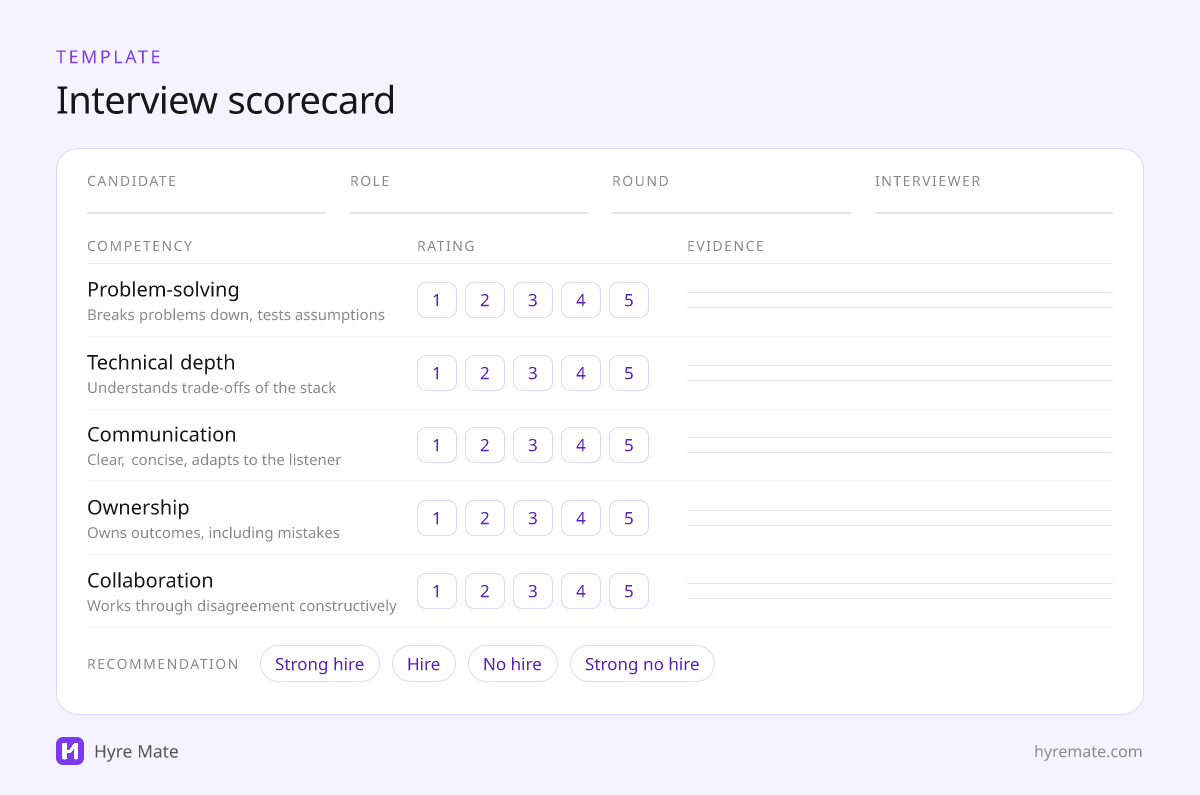
An interview scorecard (also called an interview evaluation form or candidate scorecard) is a structured form that interviewers complete during or right after an interview. It lists the criteria the role is assessed on, a rating scale for each, space to record evidence and a final recommendation.
The scorecard is the backbone of a structured interview: the same questions and the same scoring for every candidate. Without one, each interviewer quietly invents their own standard, and the debrief becomes a debate about whose gut feeling to trust.
Why use a scorecard instead of gut feel?
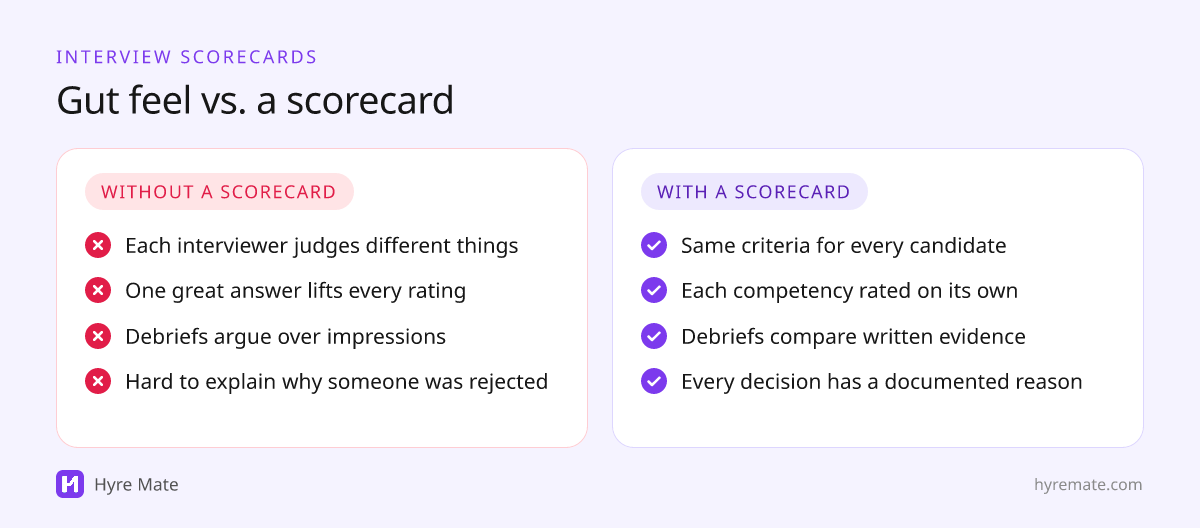
Gut feel isn't useless, but it is inconsistent. It's shaped by first impressions, by how similar a candidate seems to the interviewer and by how the previous candidate did. A scorecard narrows the room for that by enforcing three disciplines:
- Decide what matters before you meet anyone. Criteria set in advance can't drift to fit a candidate you happen to like.
- Rate each criterion separately. One impressive answer shouldn't lift every score (the halo effect), and one weak moment shouldn't sink them all.
- Write down why. A rating backed by evidence can be challenged and compared. A rating without it can only be argued about.
There's research behind this too. A major 2022 re-analysis of hiring methods by Sackett, Zhang, Berry and Lievens found that structured interviews, which rely on standardized questions and scoring, had the highest average validity for predicting job performance of the selection methods they examined. Our structured interview guide covers the numbers.
What should an interview scorecard include?
Most good scorecards share the same seven parts:
- Header details: candidate, role, interview round, interviewer and date.
- Competencies: the four to six skills or qualities this round assesses, each with a one-line definition.
- Rating scale: the same scale for every competency, such as 1 to 4 or 1 to 5.
- Rating anchors: a short description of what each score looks like for each competency.
- Evidence notes: space beside each rating for what the candidate actually said or did.
- Overall recommendation: typically strong hire, hire, no hire or strong no hire.
- Open questions: anything the next interviewer should probe.
How do you build an interview scorecard, step by step?
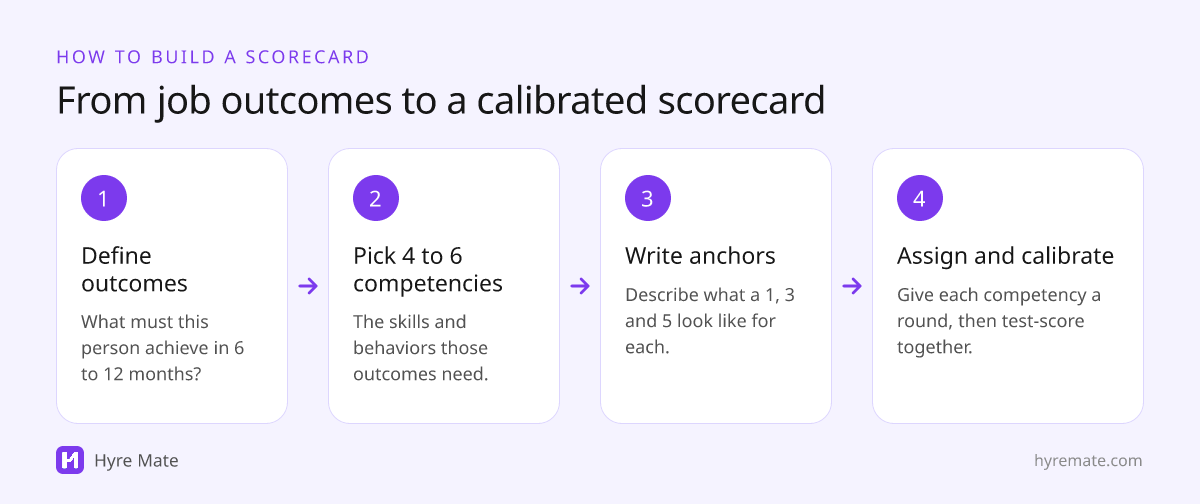
- Start from the job's outcomes. Write down what the person must achieve in their first six to twelve months. Competencies should come from those outcomes, not from a generic list.
- Choose four to six competencies. Mix skills (such as SQL or negotiation) with behaviors (such as ownership or collaboration). Go beyond six and interviewers start rating things they didn't really assess.
- Define each one in a sentence. "Communication" means different things in sales and in data engineering. Say what it means for this role.
- Write anchors for each score. Describe what a low, middle and high rating looks like in observable terms. There's an example below.
- Map competencies to rounds. Decide which interview round, and which interviewer, owns each competency, so nothing is assessed five times and nothing is missed.
- Write questions for each competency. Two or three main questions per competency, with planned follow-ups.
- Mark the non-negotiables. If a competency is a must-have, say so: a low score there is a no-hire regardless of the rest.
- Calibrate. Before going live, have two interviewers score the same practice interview or recording and compare. Disagreement usually means an anchor needs rewriting.
Which rating scale should you use?
There's no single correct scale, but the trade-offs are predictable:
| Scale | Works well when | Watch out for |
|---|---|---|
| 1–3 (below, meets, exceeds) | You need quick, simple screening decisions | Too coarse to separate strong candidates |
| 1–4 (no middle option) | You want interviewers to lean towards yes or no | Interviewers may feel pushed when evidence is mixed |
| 1–5 | You want a familiar scale with room for nuance | Ratings cluster at 3 if the anchors are vague |
| 1–10 or 0–100 | Scores are averaged or produced by software | Hard for people to tell a 6 from a 7 consistently |
For human interviewers, a 4- or 5-point scale with clear anchors is a sensible default. What matters most is that the scale is the same for every candidate and every interviewer in a round, and that each number has a written meaning.
What are rating anchors, and how do you write them?
Anchors, sometimes called behaviorally anchored rating scales, describe what each score looks like in practice. They're the difference between "4 out of 5 for communication" meaning something and meaning nothing. Here's an example for communication in a customer-facing role:
| Score | What it looks like |
|---|---|
| 1: Not demonstrated | Answers are hard to follow; doesn't adjust when asked to clarify |
| 2: Partly demonstrated | Gets the point across but rambles or relies on jargon |
| 3: Demonstrated | Clear and structured; answers the question that was asked |
| 4: Strongly demonstrated | Clear and concise, adapts to the listener and checks for understanding |
| 5: Exceptional | Explains complex topics simply and persuasively, with examples tailored to the audience |
Write anchors in observable language, meaning what the candidate said or did, rather than adjectives. "Adapts the explanation when asked a follow-up" is observable. "Articulate" is not.
Interview scorecard example: software engineer
Here's how the pieces fit together for a mid-level backend engineer. Each competency has an owning round, so the full interview loop covers everything once:
| Competency | What good looks like | Assessed in | Example question |
|---|---|---|---|
| Problem-solving | Breaks an unfamiliar problem down and tests assumptions | Coding assignment | Walk me through how you'd approach this before writing any code. |
| Technical depth | Understands the trade-offs of the tools the team uses | Technical | When would you choose a message queue over a direct API call? |
| System design | Designs for the scale and failure modes that matter | System design | Design a URL shortener that handles 10,000 requests per second. |
| Communication | Explains decisions clearly to technical and non-technical people | All rounds | Explain your last project to someone outside engineering. |
| Ownership | Takes responsibility for outcomes, including mistakes | Behavioral | Tell me about a production issue you caused. What happened next? |
If you're unsure which round should cover what, our guide to the 10 interview types explains what each round is good at.
Scorecard examples for non-technical roles
The structure stays the same for any role; only the competencies change. Three quick examples:
| Role | Competencies to score |
|---|---|
| Account executive (sales) | Discovery questioning, objection handling, pipeline discipline, negotiation, coachability |
| Customer support specialist | Written communication, empathy under pressure, troubleshooting, speed of learning the product, prioritization |
| Recruiter | Sourcing, candidate communication, stakeholder management, process discipline, judgment of fit |
Whatever the role, keep the list short enough that an interviewer can genuinely assess every item in the time available.
How do you use scorecards in the debrief?
A scorecard does its most important work in the hiring decision meeting. A simple routine keeps it honest:
- Everyone submits before the meeting. Scores and evidence are locked in before discussion, so no one is anchored by the most senior voice in the room.
- Go competency by competency. Look at all the scores for one competency at a time and discuss the evidence behind any disagreement.
- Check the must-haves first. A clear gap on a non-negotiable competency usually ends the discussion.
- Don't just average. An average of 3.4 hides whether someone is consistently solid or brilliant in one area and weak in another. Look at the pattern.
- Record the decision and the reason. A sentence or two on why you're moving forward or not, linked to the evidence on the scorecards.
What are the most common scorecard mistakes?
- Too many criteria. Twelve competencies in a 45-minute interview means most of them are guessed.
- Vague criteria like "culture fit". Replace it with the specific behaviors you mean, such as "gives direct feedback" or "works well with ambiguity".
- No anchors. Without them, a 3 from one interviewer is a 4 from another.
- Filling it in days later. Scores written from memory drift towards an overall impression.
- Treating the score as the decision. The scorecard informs a judgment; it doesn't make one.
How does Hyre Mate score interviews?
If you record or upload interviews in Hyre Mate, each one is analyzed and scored from 0 to 100 on four fixed dimensions (technical skills, communication, problem-solving and cultural fit) plus an overall score. Alongside the numbers you get a written assessment with a summary, a recommendation, suggested next steps, and strengths and weaknesses for each dimension, all backed by a speaker-labeled transcript.
Because the dimensions are the same for every interview, candidates are easy to compare, but they're not a replacement for a role-specific scorecard. Use the AI scores as a consistent second opinion alongside your own competencies, then set each candidate's status to selected, on hold or rejected once the panel has decided. You can see example output on the AI interview note-taker page.
Frequently asked questions
What is a good score on an interview scorecard?
It depends on your scale and your bar. On a 1–5 scale with clear anchors, a 3 usually means the candidate met the standard and a 4 or 5 means they exceeded it. Many teams also require a minimum score on must-have competencies, regardless of the total.
How many competencies should an interview scorecard have?
Four to six per round is a good range. Fewer than that and you may miss something important; more than that and interviewers end up rating things they didn't have time to assess.
Should every interviewer use the same scorecard?
Everyone interviewing for the same role should use the same competencies and rating scale, but each interviewer usually scores only the competencies their round is responsible for. That keeps the loop efficient and avoids assessing the same thing repeatedly.
Is a 1–5 or a 1–10 scale better for interviews?
For human interviewers, a 1–4 or 1–5 scale with written anchors is usually more reliable than 1–10, because it's hard to tell a 6 from a 7 consistently. Larger scales make more sense when scores are averaged or generated by software.
What's the difference between an interview scorecard and an interview rubric?
The terms overlap. A rubric usually means the rating definitions, or what each score looks like, while a scorecard is the full form that includes the rubric, evidence notes and a recommendation.
Can I share an interview scorecard with the candidate?
Most companies don't share scorecards directly, but you can use them to give candidates specific, job-related feedback. In some places, such as under the GDPR, candidates can request the personal data held about them, which may include interview notes and scores.