Time to hire: how to measure it and 10 ways to reduce it
What time to hire means, how it differs from time to fill, how to calculate both, where hiring usually slows down and ten practical ways to speed it up.
By the Hyre Mate team
Quick answer
Time to hire is the number of days between a candidate entering your pipeline, usually when they apply or are sourced, and accepting your offer. It's different from time to fill, which counts from when the job is opened to when an offer is accepted. Calculate time to hire for each hire and average it by role. To reduce it, measure how long candidates spend in each stage, find where they wait longest (often screening, scheduling or feedback) and fix that bottleneck first.
Key takeaways
- Time to hire measures the candidate's journey; time to fill measures the whole vacancy.
- Track time in each stage, not just the total, so you can see where candidates wait.
- Most delays are waiting time (reviews, scheduling, feedback, approvals), not evaluation time.
- Speed up by agreeing criteria early, screening fast, pre-booking interviews and deciding quickly.
- Cut waiting, not evaluation: a faster process should be just as rigorous.
What is time to hire?
Time to hire measures how quickly you move a candidate from first contact to accepted offer. It's a measure of your process's speed from the candidate's point of view: how long someone you want waits for you to decide.
Time to hire formula
Time to hire = date the offer was accepted − date the candidate entered the pipeline
Average time to hire = sum of time to hire for all hires in a period ÷ number of hires
What's the difference between time to hire and time to fill?
| Time to hire | Time to fill | |
|---|---|---|
| Starts | When the candidate applies or is sourced | When the job is approved or opened |
| Ends | When the candidate accepts the offer | When the offer is accepted (sometimes the start date) |
| Measures | How fast you process a candidate | How long the vacancy stays open |
| Mostly affected by | Screening, interviews, feedback and offers | All of that, plus sourcing and how quickly good candidates apply |
| Best for | Spotting slow stages in your process | Workforce planning and hiring manager expectations |
Both are useful. If time to fill is long but time to hire is short, your problem is attracting candidates. If time to hire itself is long, the problem is inside your process.
How do you calculate time to hire?
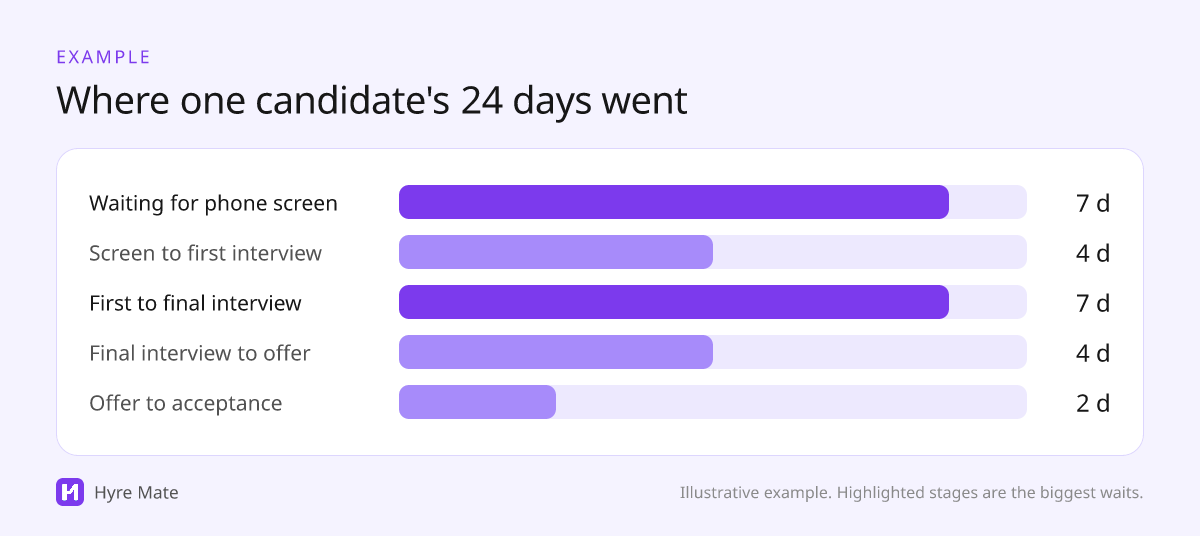
Record the date of each stage change for every candidate you hire: applied, screened, interviewed, final round, offered and accepted. Then subtract. Here's an example hire:
| Stage | Date | Days in stage |
|---|---|---|
| Applied | March 3 | – |
| Phone screen | March 10 | 7 |
| First interview | March 14 | 4 |
| Final interview | March 21 | 7 |
| Offer made | March 25 | 4 |
| Offer accepted | March 27 | 2 |
| Time to hire | 24 days |
Three tips make the number more useful:
- Use calendar days, including weekends, because that's what candidates experience.
- Look at the median as well as the average, so one unusually slow hire doesn't distort the picture.
- Break it down by role and by stage. An engineering hire and a sales hire have different processes; compare like with like.
What is a good time to hire?
There's no universal target, because it depends on the role, seniority, industry and location. For a reference point, SHRM's 2025 recruiting benchmarking puts the median time to fill in the US at roughly a month and a half, measured in calendar days from opening the requisition to the accepted offer (SHRM). Time to hire is a shorter window, since it starts when the candidate enters the pipeline.
The most useful benchmark is your own history. Track time to hire by role for a quarter, then aim to reduce the slowest stage. That's more actionable than comparing yourself with an industry average built from very different jobs.
Why does hiring take so long?
When you break time to hire into stages, most of the time usually turns out to be waiting rather than evaluating. Common causes:
- Slow resume review. Applications sit unread for days because reviewing them is tedious.
- Scheduling back-and-forth. Finding a slot for a candidate and two or three busy interviewers takes several rounds of messages.
- Too many rounds. Extra interviews get added "to be sure", often re-testing the same skills.
- Slow feedback. Interviewers take days to submit notes, and the debrief waits for the last one.
- Unclear criteria. Without an agreed bar, the panel can't decide and asks for another round.
- Offer approvals. Salary sign-off starts only after the final interview, adding days at the end.
How can you reduce time to hire? 10 practical ways
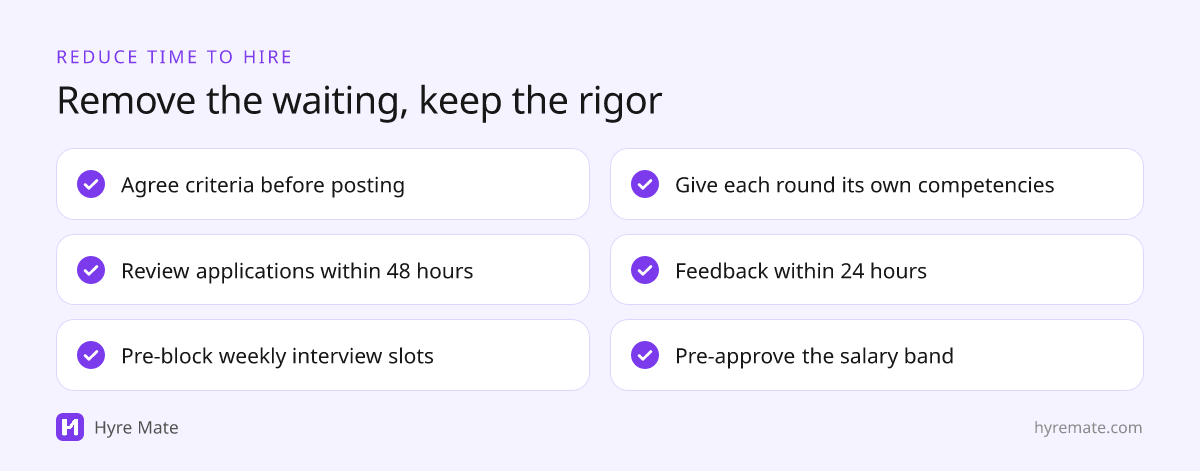
- Agree the criteria before you post the job. A short scorecard agreed with the hiring manager prevents "let's see one more" delays later.
- Write a precise job description. Clear must-haves attract fewer unsuitable applicants and make screening faster. An AI job description generator gets you a structured first draft in minutes.
- Screen applications daily. Set a rule that every application is reviewed within one or two working days, and use AI scoring to handle volume.
- Phone screen quickly. Book screening calls within days of the application, using a consistent script.
- Pre-block interview slots. Ask interviewers to hold recurring slots each week for this role, so scheduling is a pick, not a negotiation.
- Cut redundant rounds. Give each round specific competencies to assess. If two rounds test the same thing, merge them.
- Require feedback within 24 hours. Make it a team norm, and make it easy with templates or AI notes.
- Hold the debrief right after the final round. Same day if possible, while the evidence is fresh.
- Pre-approve the salary band. Get compensation signed off before interviews start, so the offer can go out the day you decide.
- Keep candidates informed. Tell candidates the timeline up front and update them at each stage, so they're less likely to accept another offer while waiting.
Which metrics should you track alongside time to hire?
| Metric | How to calculate it | What it tells you |
|---|---|---|
| Time to fill | Date offer accepted − date job opened | How long the vacancy stays open |
| Time in stage | Date candidate left a stage − date they entered it | Where candidates wait |
| Stage pass-through rate | Candidates advancing from a stage ÷ candidates entering it | Whether a stage is too strict or too loose |
| Offer acceptance rate | Offers accepted ÷ offers made | Whether your offers and process are competitive |
| Candidate drop-off | Candidates who withdraw at each stage | Where slowness or experience costs you people |
| Quality of hire | For example, performance ratings or retention after a set period | Whether speed is costing you quality |
Does a faster process mean worse hires?
Not if you cut the right things. Most of the time in a slow process is spent waiting: for someone to read an application, for a calendar slot, for feedback. Removing that waiting doesn't make evaluation any less rigorous.
Where speed does hurt quality is when teams skip structure, such as dropping the scorecard, deciding on gut feel or skipping reference checks under pressure. Keep the evaluation steps that matter, and make everything around them faster. A structured interview process actually helps here, because agreed questions and criteria make decisions quicker.
How can Hyre Mate help you hire faster?
Hyre Mate targets the slow, manual steps in the middle of the process:
- Job descriptions: generate a structured draft (description, responsibilities, requirements and education) from a one-line prompt.
- Resume screening: upload resumes in bulk, then score candidates against the job from 0 to 100, with matched and missing skills, so you know who to call first.
- Interviews: schedule across ten interview types, generate questions for each round, and record from your microphone or a browser tab.
- Feedback: get AI notes, a transcript, scores and a written assessment after each interview, so write-ups don't hold up the debrief.
Hyre Mate doesn't calculate time to hire for you, so track the metric in your applicant tracking system or a spreadsheet, and use it to see which stages get faster. The free plan includes 100 resume analyses and 20 interview analyses a month.
Frequently asked questions
What's the difference between time to hire and time to fill?
Time to hire runs from when a candidate enters your pipeline to when they accept an offer. Time to fill runs from when the job is opened to when an offer is accepted, so it also includes the time spent attracting candidates.
How do you calculate average time to hire?
For each hire in a period, subtract the date they entered the pipeline from the date they accepted the offer. Add those numbers together and divide by the number of hires. Looking at the median as well helps reduce the effect of unusual cases.
What is a good time to hire?
It depends on the role and market, so the best benchmark is your own history by role. For context, SHRM's 2025 benchmarking puts the median US time to fill at roughly a month and a half, and time to hire is a shorter window within that.
Does time to hire include weekends?
Usually yes. Most teams measure in calendar days, including weekends and holidays, because that's how long the candidate actually waits.
Why is time to hire important?
Strong candidates often have several options, so long waits between stages can cost you hires. Time to hire also shows where your process wastes interviewer and recruiter time.
Which hiring stage usually takes the longest?
It varies by team, which is why it's worth measuring time in each stage. Common bottlenecks are the wait for an initial resume review, scheduling interviews and collecting feedback after interviews.