Phone screen interview questions: a recruiter's script and checklist
The phone screen questions recruiters should ask, a 30-minute script, questions to avoid, real and false red flags, and how to decide who moves forward.
By the Hyre Mate team
Quick answer
A phone screen is a short first-round call, usually 15 to 30 minutes, that confirms a candidate meets the role's basic requirements before you invest in full interviews. Ask the same core questions every time: why they're interested, a quick walk through their relevant experience, one or two checks on must-have skills, and logistics such as location, start date, work authorization and salary expectations. Then score the call against the same criteria for every candidate and tell them the outcome quickly.
Key takeaways
- A phone screen confirms must-haves and mutual interest. It isn't a full interview.
- Use the same script and criteria for every candidate for the role.
- Cover motivation, relevant experience, must-have skills and logistics in about 30 minutes.
- Ask about salary expectations, not salary history, which many US states ban.
- Decide the same day and tell candidates promptly, because strong candidates have other options.
What is a phone screen interview?
A phone screen (or screening call) is usually the first conversation between a candidate and the company. It's typically run by a recruiter or the hiring manager, by phone or a short video call, and it has three jobs:
- Confirm the must-haves. Does the candidate have the essential experience, skills and logistics the role requires?
- Check mutual interest. Is the role what the candidate is looking for, in pay, location, scope and timing?
- Sell the role and set expectations. Explain the job, the team and what the rest of the process looks like.
Screening is the first of the ten common interview types and the cheapest filter in your process. Keep it short, consistent and focused, and save deep skill assessment for later rounds.
How long should a phone screen be?
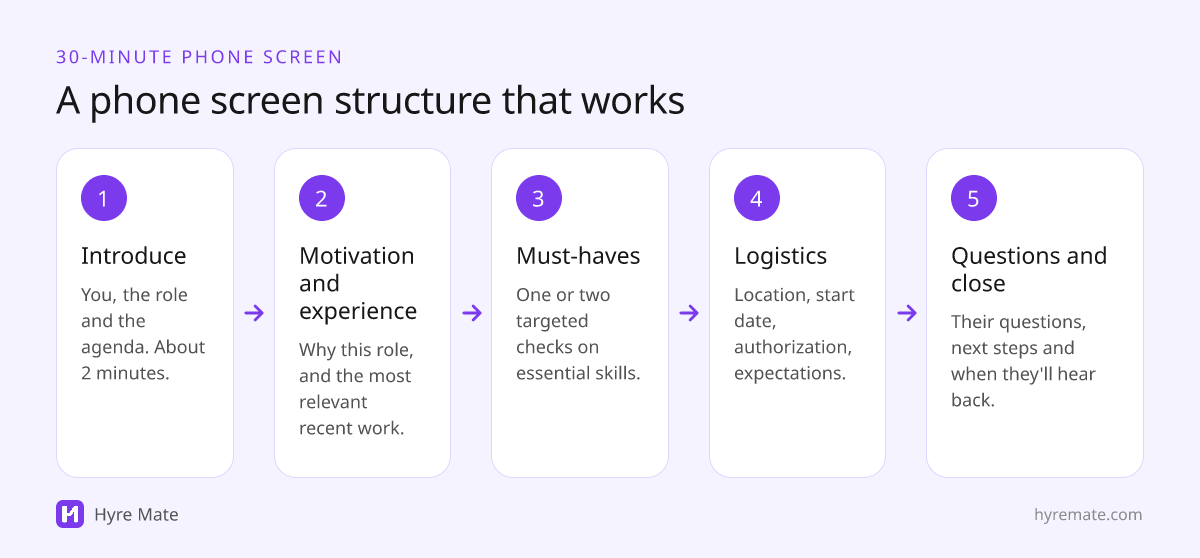
Fifteen to thirty minutes is enough for most roles. Here's a simple 30-minute structure:
| Segment | Time | Goal |
|---|---|---|
| Introduction | 2 min | Introduce yourself, the role and the agenda |
| Motivation | 4 min | Why this role, why now |
| Experience | 8 min | Walk through the most relevant recent work |
| Must-have skills | 6 min | One or two targeted checks on essentials |
| Logistics | 4 min | Location, start date, authorization, salary expectations |
| Candidate questions | 4 min | Answer what they want to know |
| Close | 2 min | Explain next steps and when they'll hear back |
What questions should you ask in a phone screen?
Motivation and interest
- What made you apply for this role?
- What are you looking for in your next position that you don't have now?
- What do you know about what we do?
- Why are you looking to move now?
Experience and background
- Walk me through your current role. What are you responsible for day to day?
- Which part of your experience is most relevant to this job?
- Tell me about a recent project you're proud of. What was your part in it?
- What size of team do you work in, and who do you report to?
- What's a skill you've developed most in the last year?
Must-have skills
Turn each must-have requirement into a short, specific question. For example:
- "This role owns renewals for about 40 accounts. How many accounts do you manage today, and how do you prioritize them?"
- "We use PostgreSQL heavily. Tell me about the most demanding query or schema problem you've dealt with."
- "The job involves presenting to clients weekly. When did you last do that, and how did it go?"
Logistics
- This role is [remote / hybrid in a city / on-site]. Does that work for you?
- If you were offered the job, when could you start? Do you have a notice period?
- Are you legally authorized to work in [country]? Will you now or in the future require visa sponsorship?
- What salary range are you looking for?
- Are you interviewing elsewhere, and is there a timeline we should know about?
To close
- What questions do you have for me about the role or the team?
- Is there anything about your experience we haven't covered that you'd want the hiring manager to know?
Phone screen script you can use
Phone screen script
Open: "Hi [name], thanks for making time. I'm [your name], the recruiter for the [role] position. We have about 30 minutes. I'll tell you a little about the role, ask about your background, cover a few practical questions, and leave time for yours. Sound good?"
Role pitch (60 seconds): what the team does, what this person will own in their first six months, and why the role is open.
Questions: motivation, experience, must-haves and logistics, in the same order for every candidate.
Close: "Thanks, this was really helpful. The next step is [a 45-minute interview with the hiring manager]. I'll get back to you by [day] either way."
Write down evidence as you go rather than impressions. Our guide to taking interview notes covers what to capture.
What questions should you avoid in a phone screen?
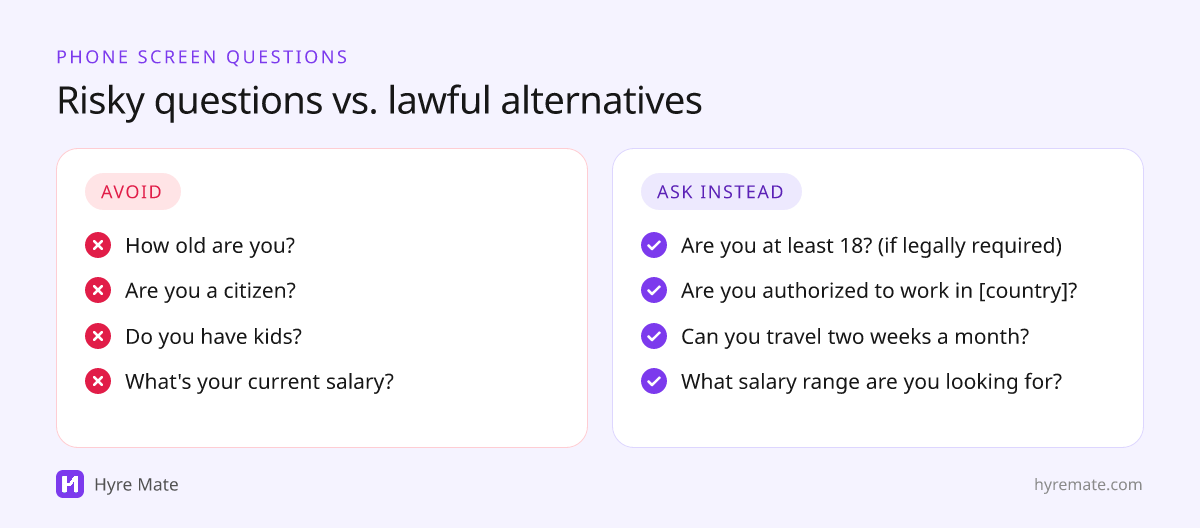
Some questions are illegal or risky in many jurisdictions because they touch on protected characteristics. Almost every one has a lawful, job-related alternative:
| Avoid | Ask instead |
|---|---|
| How old are you? | Are you at least 18? (only if the role legally requires it) |
| Where are you from? Are you a citizen? | Are you legally authorized to work in [country]? |
| Do you have children, or plan to? | This role involves travel two weeks a month. Is that workable for you? |
| Do you have any disabilities or health issues? | Can you perform the essential functions of this job, with or without reasonable accommodation? |
| What religion do you practice? | This role includes some weekend shifts. Can you work that schedule? |
| What's your current salary? | What salary range are you looking for? |
Salary history deserves a special mention. There's no federal ban in the US, but roughly twenty states plus Washington, D.C., and a number of cities restrict asking applicants about their pay history, and the list keeps growing; Virginia's ban took effect on July 1, 2026. Asking about expectations instead is lawful almost everywhere and more useful anyway.
What are real red flags in a phone screen, and what aren't?
Real red flags are job-related:
- They can't describe their own work in specifics, even when prompted.
- A must-have requirement clearly isn't met.
- Logistics fundamentally don't work, such as a start date months beyond what you need or an on-site role they won't relocate for.
- They're dismissive or disrespectful about past colleagues or to you.
Plenty of things that feel like red flags aren't, and treating them as such filters out good people unfairly:
- Nervousness. Phone calls make many people anxious, and it says little about job performance.
- An accent, unless a specific language is genuinely required for the job, and even then assess the skill, not the accent.
- Employment gaps. Ask neutrally if relevant, but gaps have many ordinary explanations.
- Career changes. Transferable experience is often exactly what a team needs.
How do you decide who moves forward?
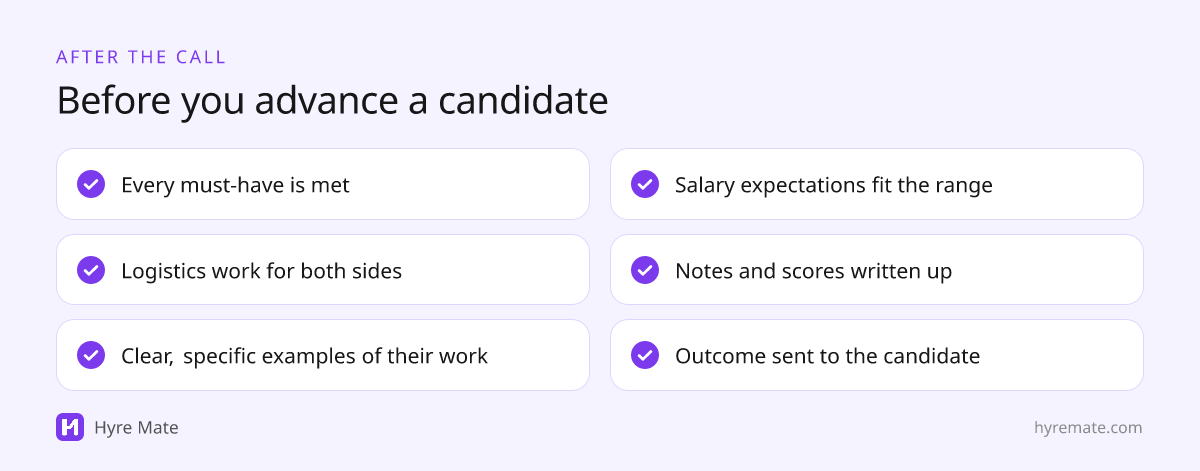
Score every call against the same short list: each must-have (met or not met), motivation and fit with the role, and logistics. A simple rule works well: anyone who meets every must-have and has workable logistics goes forward; anyone who misses a must-have doesn't; anyone in between gets a second look from the hiring manager.
Make the decision the same day and tell the candidate promptly, with a short, specific note if you're not moving forward. See how to write interview feedback for examples.
How can AI make phone screens faster?
The best way to save time on phone screens is to call the right people. With Hyre Mate's resume screening, you can upload resumes in bulk and analyze candidates against the job. Each analysis gives an overall score from 0 to 100 with a breakdown for skills match, experience relevance, education match, technical skills and soft skills, plus matched and missing skills, so you can decide who to call first.
During the call, screening is one of the ten interview types the interview copilot supports: it can generate questions for the role and record from your microphone, with the candidate's consent. Afterwards you get a transcript, AI notes and scores, so you're not writing up the call from memory. Check the consent rules for recording where you and the candidate are before you record.
Frequently asked questions
What questions are asked in a phone screen?
Most phone screens cover why the candidate is interested, a walk through their relevant experience, one or two checks on must-have skills, and logistics such as location, start date, work authorization and salary expectations, followed by the candidate's own questions.
How long is a phone screen interview?
Usually 15 to 30 minutes. That's enough to confirm must-haves and mutual interest without turning the call into a full interview.
What's the difference between a phone screen and a phone interview?
A phone screen is a short qualifying call to confirm basic fit. A phone interview is a full interview that happens to take place by phone, with deeper questions about skills and experience.
Should you ask about salary in a phone screen?
Ask about salary expectations so you don't waste anyone's time, but avoid asking about salary history. Many US states and cities ban pay history questions, and expectations are more useful for setting an offer anyway.
Who should conduct the phone screen?
Usually a recruiter, because the screen focuses on must-haves, motivation and logistics. For specialist roles, a hiring manager or team member sometimes runs it or joins to check a key skill.
Can you record a phone screen?
Yes, with the candidate's consent. Several US states require everyone on a call to consent to recording, so tell candidates in advance and confirm at the start of the call.