How to shortlist candidates: a step-by-step guide for recruiters
How to shortlist candidates fairly and quickly: set criteria before you read, screen in passes, score with weights, check for bias and use AI for volume.
By the Hyre Mate team
Quick answer
To shortlist candidates, define your must-have and nice-to-have criteria before you open a single application. Screen every applicant against the must-haves first, then score the remaining candidates against the same weighted criteria and invite the highest-scoring group to the next stage. Record why each candidate was or wasn't shortlisted, and check that your criteria aren't screening out groups of people for reasons unrelated to the job.
Key takeaways
- Write the criteria down before reading applications, so they can't drift to fit candidates.
- Screen in two passes: knock-out criteria first, weighted scoring second.
- Score every candidate against the same criteria and weights, and note the reason for each decision.
- Size the shortlist to your interview capacity, not to a fixed number.
- Watch for proxies such as school names or employment gaps, and check pass-through rates by group.
What is candidate shortlisting?
Shortlisting is the step between receiving applications and inviting people to interview. You narrow a large pool of applicants down to a small group who best match the role's requirements and who you'll invest interview time in.
| Longlist | Shortlist | |
|---|---|---|
| What it is | Everyone who meets the basic requirements | The strongest candidates you'll interview |
| How it's built | Knock-out criteria | Weighted scoring against the role |
| Typical size | Dozens or hundreds | Small enough to interview properly |
| Next step | Detailed review | Phone screen or first interview |
Shortlisting overlaps with resume screening. In practice, screening is the act of reviewing applications; shortlisting is the decision about who goes forward.
Why does shortlisting go wrong?
Most shortlisting problems come from doing it informally, one application at a time, without written criteria:
- Criteria drift. The bar shifts as you read: an impressive early applicant raises it, a weak batch lowers it.
- Fatigue. Application 200 gets a fraction of the attention application 5 did.
- Order effects. Whoever applied first, or whose application you read when you were fresh, gets an advantage.
- Proxies. Brand-name employers, particular universities or an unbroken work history stand in for actual skills, and quietly exclude capable people.
- No record. When nobody wrote down why someone was rejected, the decision can't be checked or explained.
How do you shortlist candidates, step by step?
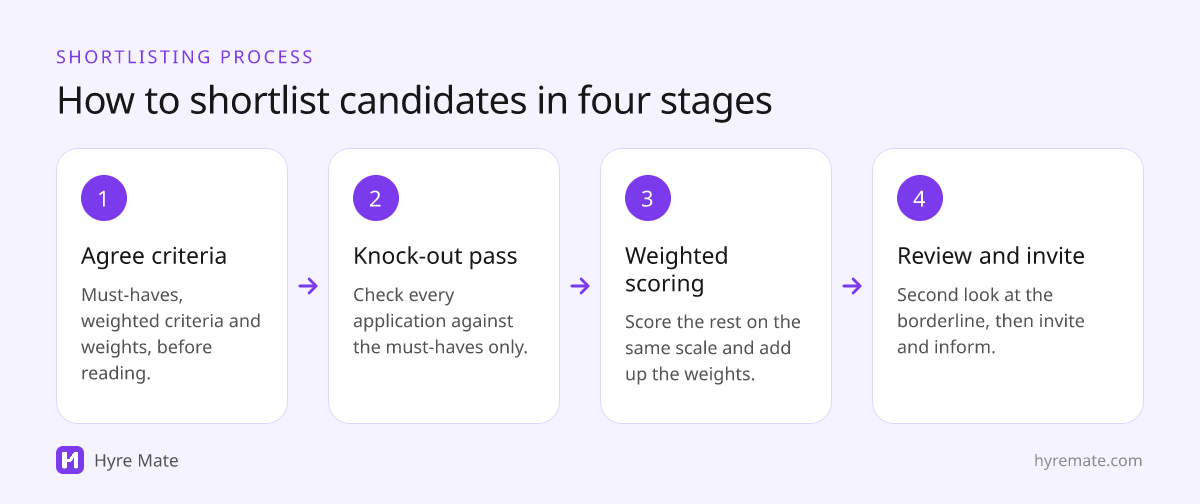
- Agree the criteria with the hiring manager. Separate must-haves (knock-outs) from weighted criteria and nice-to-haves, and write them down before the job goes live.
- Decide the weights. Which weighted criteria matter most? Agree percentages that add up to 100.
- Set the shortlist size. Work back from how many interviews the team can realistically run in the next two weeks.
- First pass: knock-outs only. Check every application against the must-haves and nothing else. This pass should be fast and mechanical.
- Second pass: score. Score each remaining candidate against every weighted criterion on the same scale.
- Rank and review. Rank by weighted score, then have a second person review the borderline candidates just above and below the line.
- Record and communicate. Note the reason for each decision, invite the shortlist and tell everyone else promptly.
How do you set shortlisting criteria?
Good criteria are job-related, observable in an application, and agreed before you start. Sort them into three types:
| Type | What it means | Example | How it's applied |
|---|---|---|---|
| Must-have (knock-out) | Without it, the person can't do the job | Legally authorized to work in the country; licensed nurse | Pass or fail |
| Weighted | Important, and the more the better | Relevant experience; specific technical skills | Scored, for example 1 to 5 |
| Nice-to-have | Helpful, but learnable on the job | Industry knowledge; a particular tool | Tie-breaker only |
Keep must-haves to a genuine minimum. Every extra knock-out shrinks your pool, and long requirement lists also discourage good candidates from applying at all. A precise job description makes this step much easier.
How do you score candidates for a shortlist?
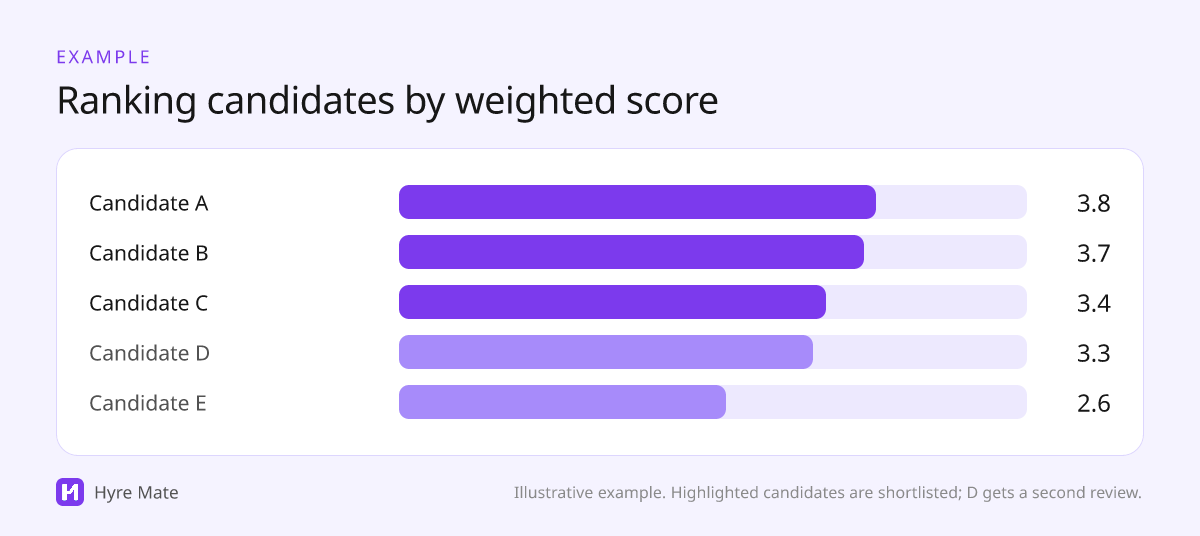
Weighted scoring turns judgment into something comparable. Score each criterion from 1 to 5, multiply by its weight, and add the results. Here's an example for a customer success role:
| Criterion | Weight | Candidate A | Candidate B |
|---|---|---|---|
| Relevant customer-facing experience | 40% | 4 | 3 |
| Account management skills | 30% | 3 | 5 |
| Industry knowledge | 20% | 5 | 3 |
| Written communication (application) | 10% | 3 | 4 |
| Weighted score | 100% | 3.8 | 3.7 |
Candidate A's score is 4 × 0.4 + 3 × 0.3 + 5 × 0.2 + 3 × 0.1 = 3.8. The scores are close, which is exactly when a second reviewer and the written evidence behind each number matter most.
How many candidates should you shortlist?
There's no universal number. Size the shortlist to what the next stage can handle well. If your hiring manager can do six first interviews in the next fortnight, a shortlist of six to eight (allowing for drop-outs) is sensible. A shortlist of twenty that waits three weeks for interviews loses candidates to faster employers.
If the shortlist is too small, revisit the criteria before lowering the bar: is a must-have really essential, or is it a nice-to-have that's knocking out good people?
How do you keep shortlisting fair?
- Use the same criteria and weights for everyone, and apply them in the same order.
- Hide details that aren't job-related where your tools allow, such as names, photos and dates of birth.
- Judge skills, not proxies. Ask what a university or a big-name employer is standing in for, and assess that directly.
- Don't treat gaps as a knock-out. Career breaks have many ordinary explanations.
- Check pass-through rates. Compare the share of each group that makes the shortlist.
For that last check, US enforcement agencies use the "four-fifths rule" from the Uniform Guidelines on Employee Selection Procedures as a rule of thumb: if one group's selection rate is less than 80% of the rate for the group with the highest rate, that's generally treated as evidence of adverse impact (29 CFR 1607.4(D)). It's a screening signal, not a legal safe harbor, but it's a useful prompt to look again at your criteria.
How do you document shortlisting decisions?
A short record for every applicant makes decisions consistent, lets a second reviewer check your reasoning and answers questions later if a decision is challenged. It doesn't need to be long:
Shortlisting record
Candidate: Candidate B · Role: Customer Success Manager · Reviewer: [name] · Date: [date]
Must-haves: all met (work authorization; two or more years in a customer-facing role)
Weighted score: 3.7 (experience 3, account management 5, industry 3, writing 4)
Decision: Shortlisted. Strongest account management evidence in the pool: ran renewals for 35 accounts.
Write the reason in terms of the agreed criteria, never personal characteristics, and keep it for your normal hiring-records retention period.
How can AI help you shortlist candidates?
AI is most useful on the slow, repetitive part of shortlisting: reading every application against the same criteria. With Hyre Mate's AI resume screening, you can upload resumes in bulk (PDF, DOC, DOCX, TXT, JPG or PNG), have each one parsed into a candidate profile, and analyze candidates against the job. Each analysis includes:
- An overall score from 0 to 100 against the role
- A breakdown for skills match, experience relevance, education match, technical skills and soft skills
- Matched and missing skills, so you can see the must-haves at a glance
- Strengths, areas for improvement and written feedback explaining the score
Use the scores to decide what to read first and where to look closely, not to reject people automatically. AI can repeat patterns in the data it learned from: Amazon famously scrapped an experimental AI résumé-ranking tool after finding it penalized women's applications for technical roles (Reuters, 2018). Keep a person responsible for every shortlisting decision, and check the results for adverse impact. The free plan includes 100 resume analyses a month; see how to screen resumes faster with AI for a full workflow.
What are the most common shortlisting mistakes?
- Deciding criteria after reading applications, which lets the first strong candidate define the role.
- Too many must-haves, which shrink the pool and exclude people who could learn the gaps.
- Shortlisting more people than you can interview quickly, so strong candidates accept other offers while they wait.
- Leaving rejected candidates in silence. A short, prompt note protects your reputation.
- Trusting a score without reading the evidence, whether it came from a person or a tool.
Frequently asked questions
What does it mean to be shortlisted for a job?
Being shortlisted means the employer has reviewed the applications and selected you as one of the strongest candidates to move to the next stage, usually a phone screen or first interview.
What criteria should be used to shortlist candidates?
Job-related criteria agreed with the hiring manager before reviewing applications: a small number of must-haves that are pass or fail, weighted criteria such as relevant experience and key skills, and nice-to-haves used only as tie-breakers.
How many candidates should be on a shortlist?
Enough to fill the next stage without long waits. Work back from how many interviews the team can run in the next week or two, and add a small buffer for candidates who drop out.
What's the difference between screening and shortlisting?
Screening is reviewing applications against the requirements. Shortlisting is the resulting decision about which candidates move forward to interviews. Screening usually produces a longlist; shortlisting narrows it down.
Can AI shortlist candidates?
AI can score and rank applications against a job, which saves a lot of reading time. A person should still review the results and make the decision, and you should check outcomes for bias, because AI can repeat patterns from historical data.
Should you tell candidates they weren't shortlisted?
Yes. A short, prompt message is respectful and protects your employer brand. It doesn't need detailed feedback at this stage, but it should be clear that you're not moving forward.