What is a structured interview? A practical guide with examples
What a structured interview is, why research ranks it among the best predictors of job performance, and how to design and run one, with example questions.
By the Hyre Mate team
Quick answer
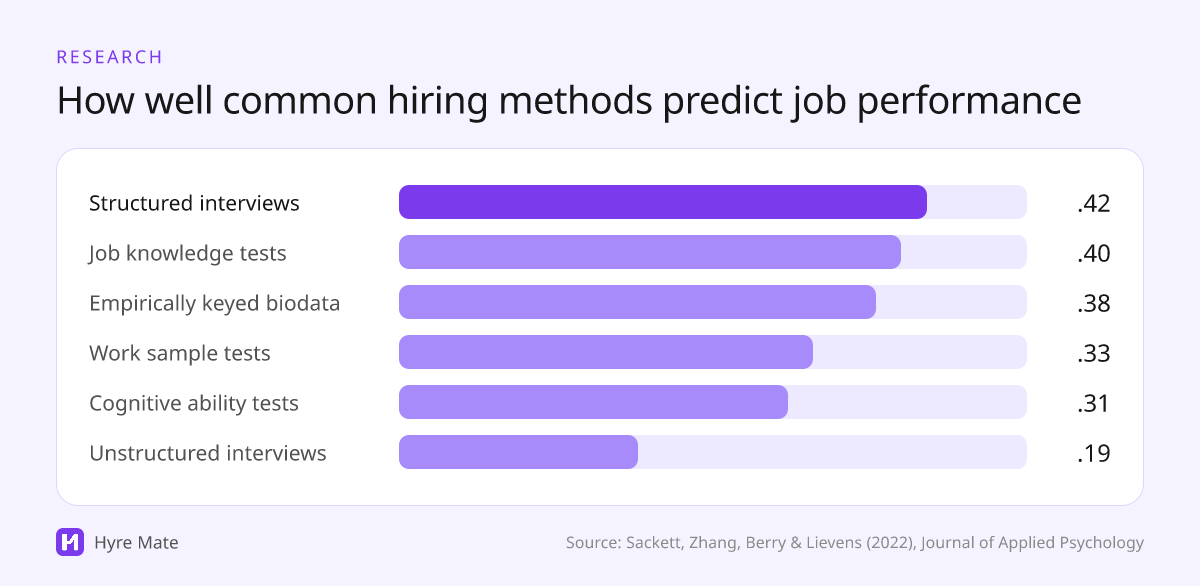
A structured interview is a job interview in which every candidate for a role is asked the same job-related questions, in the same order, and their answers are scored against the same predefined rating scale. Research on hiring methods consistently finds structured interviews among the most predictive tools available: a 2022 re-analysis by Sackett and colleagues ranked them highest of the methods it examined, with an average validity of .42.
Key takeaways
- Structure means the same questions, the same order and the same scoring for every candidate.
- In a 2022 re-analysis of hiring research, structured interviews had the highest average validity of the methods studied (.42), well ahead of unstructured interviews (.19).
- Use behavioral ("tell me about a time") and situational ("what would you do if") questions tied to job competencies.
- Planned follow-up probes are fine. Improvised topic changes are not.
- Most of the work happens upfront: job analysis, questions and rating anchors.
What is a structured interview?
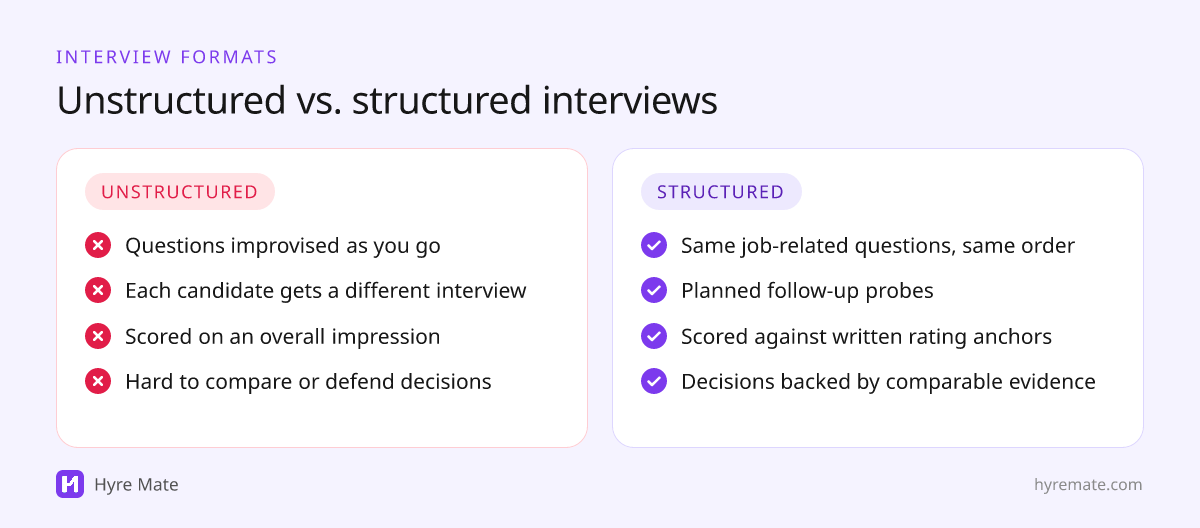
In a structured interview, the interview itself is designed before any candidate is invited. The interviewers agree on what the job requires, write questions that test those requirements and decide in advance what a good, average and poor answer looks like. Then every candidate gets the same experience: the same questions, asked the same way, scored on the same scale.
Compare that with a typical unstructured interview, where the conversation follows the interviewer's curiosity and the candidate's CV, and the outcome is an overall impression. Unstructured interviews can feel more natural, but two candidates for the same job may end up being assessed on completely different things.
Structured vs. semi-structured vs. unstructured interviews
| Structured | Semi-structured | Unstructured | |
|---|---|---|---|
| Questions | Same set for every candidate, fixed in advance | Core questions fixed, others vary | Improvised during the conversation |
| Order | Same order every time | Mostly the same | No set order |
| Follow-ups | Planned probes only | Planned plus some improvised | Entirely improvised |
| Scoring | Anchored rating scale per question or competency | Often a scorecard, sometimes loose | Overall impression |
| Comparability | High | Medium | Low |
| Best for | Most hiring decisions | Senior or unusual roles that need flexibility | Informal chats, not decisions |
Why do structured interviews predict performance better?
Industrial-organizational psychologists measure how well a hiring method predicts job performance with a validity coefficient: the correlation between how candidates score on the method and how well they later perform. Zero means no relationship; higher numbers mean a stronger one.
For decades, the most-cited figures came from a 1998 review by Frank Schmidt and John Hunter. In 2022, Paul Sackett, Charlene Zhang, Christopher Berry and Filip Lievens re-examined those estimates in the Journal of Applied Psychology. They argued that earlier studies had over-corrected for a statistical issue called range restriction, which inflated many validity figures. Their revised estimates were lower across the board, but structured interviews came out on top of the methods they examined.
| Selection method | Schmidt & Hunter (1998) | Sackett et al. (2022) |
|---|---|---|
| Structured interviews | .51 | .42 |
| Cognitive ability tests | .51 | .31 |
| Unstructured interviews | .38 | .19 |
A few caveats are worth knowing. These are averages across many studies, and the spread is wide: Sackett and colleagues report an 80% credibility interval of roughly .18 to .66 for structured interviews, so how you design and run them matters a great deal. And a validity of .42 is strong by the standards of hiring research but far from perfect prediction. Structure makes interviews better; it doesn't make them infallible.
Why does structure help? Mostly because it removes noise:
- Everyone answers the same questions, so differences in scores reflect differences between candidates rather than between conversations.
- Questions come from the job, so the interview measures what matters for performance rather than rapport.
- Answers are scored against anchors, which limits the influence of first impressions and interviewer mood.
- Scores are recorded per question or competency, so one great or terrible moment doesn't dominate the outcome.
What are the key components of a structured interview?
- A job analysis. A short written list of what the role requires, usually gathered from the hiring manager and people who already do the job well.
- Competency-based questions. Each question targets one or two of those requirements.
- Fixed order and wording. Every candidate hears the same questions, asked the same way.
- Planned follow-up probes. Prepared prompts such as "What did you do next?" that draw out complete answers without changing the question.
- Anchored rating scales. Descriptions of a poor, acceptable and excellent answer for each question or competency.
- Note-taking. Interviewers record evidence as they go.
- Independent scoring. Each interviewer scores before any group discussion.
- Interviewer training. Short practice sessions so everyone applies the scale the same way.
What types of questions are used in structured interviews?
Most structured interviews use a mix of three question types:
| Type | Format | What it reveals | Example |
|---|---|---|---|
| Behavioral | Asks about past experience | How the candidate actually behaved in a real situation | Tell me about a time you had to deliver bad news to a customer. What did you do? |
| Situational | Poses a hypothetical scenario | How the candidate reasons through a job-relevant problem | A key client asks for a feature your team can't build this quarter. How do you respond? |
| Job knowledge | Asks directly about a skill | Whether the candidate knows what the role requires | How would you find the slowest queries in a PostgreSQL database? |
Behavioral questions work well for experienced candidates. Situational questions help when candidates may not have faced the exact situation before, such as graduates or career changers.
How do you run a structured interview?
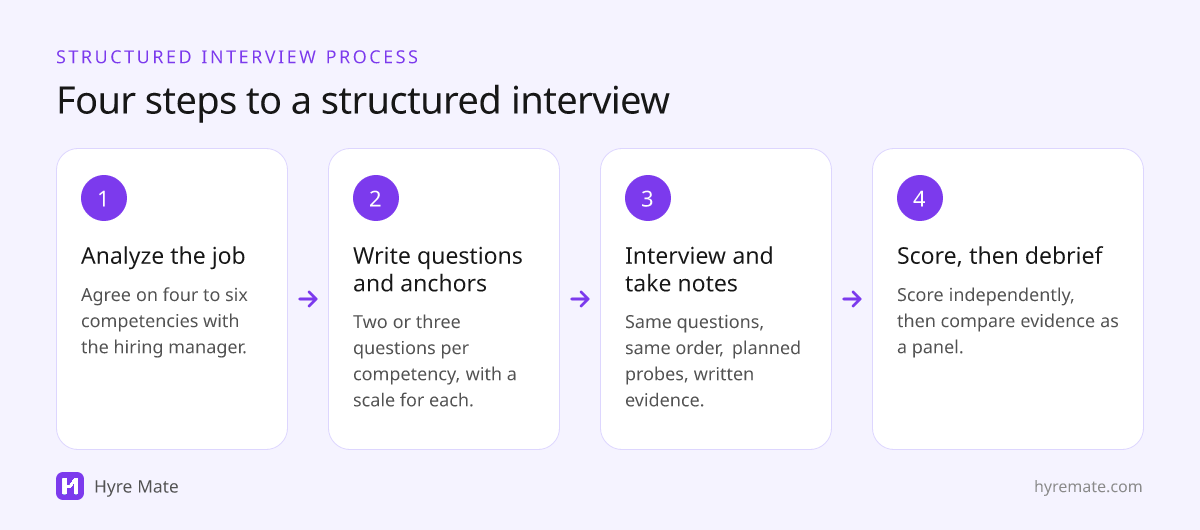
- Do the job analysis. Agree on four to six competencies with the hiring manager.
- Write the questions. Two or three per competency, plus planned probes.
- Write the rating anchors. Describe what a 1, a 3 and a 5 answer look like for each question.
- Brief the candidate. Explain the format at the start: you'll ask a set of prepared questions and take notes. Most candidates find this reassuring rather than cold.
- Ask, probe and take notes. Stick to the script, use planned probes to get complete answers and record evidence.
- Score immediately and independently. Rate each answer against its anchors before talking to other interviewers.
- Decide in a debrief. Compare scores competency by competency and discuss the evidence.
A scorecard holds all of this together. If you don't have one yet, start with our interview scorecard template, and see how to take interview notes for capturing evidence during the conversation.
Structured interview question examples
Here are example questions for common competencies. Use them as a starting point and adapt the wording to your role:
| Competency | Behavioral question | Situational question |
|---|---|---|
| Problem-solving | Tell me about a problem at work you didn't know how to solve at first. How did you work it out? | Your weekly report suddenly shows a 30% drop in sign-ups. What do you check first? |
| Collaboration | Describe a time you disagreed with a teammate about how to do something. What happened? | Two teammates ask for help with urgent work at the same time. How do you handle it? |
| Ownership | Tell me about a mistake you made that affected others. What did you do about it? | You notice a bug in a feature another team shipped. What do you do? |
| Communication | Tell me about a time you had to explain something complex to a non-expert. | You need to tell a client their project will be two weeks late. How do you approach the conversation? |
| Adaptability | Describe a time your priorities changed suddenly. How did you adjust? | Halfway through a project, the goal changes. What are your first steps? |
What are the drawbacks of structured interviews?
Structured interviews come with trade-offs, and it helps to plan for them:
- Upfront effort. Job analysis, questions and anchors take time to write. Once written, though, they're reusable for every hire into the role.
- They can feel stiff. Explaining the format at the start, leaving time for the candidate's questions and keeping a warm tone go a long way.
- Less room to explore. If something interesting comes up, note it for a later round instead of abandoning the structure.
- Interviewers push back. Experienced interviewers often trust their instincts. Calibration sessions, where they see how differently colleagues score the same answer, tend to persuade them more than research does.
How can AI help you run structured interviews?
AI is most useful for the tedious parts of structure, not the judgment itself. In Hyre Mate, the interview copilot generates an opening set of questions from the role and lets you ask for more, similar or follow-up questions as the conversation develops, which is handy for drafting a question bank and planned probes. It supports ten interview types, from screening to system design.
After the interview, recordings and transcripts are scored on the same four dimensions every time (technical skills, communication, problem-solving and cultural fit) plus an overall score, with a speaker-labeled transcript to check the evidence. That consistency complements your structured scorecard; it doesn't replace it. Keep the questions and anchors your team agreed on as the standard, and let the AI handle capture and summarizing.
Frequently asked questions
Can you ask follow-up questions in a structured interview?
Yes, as long as they're planned. Prepared probes such as "What was your role specifically?" or "What happened next?" help candidates give complete answers. What you avoid is improvising new topics for some candidates and not others.
How many questions should a structured interview have?
A common pattern is two or three questions for each of four to six competencies, or roughly eight to twelve questions in a 45 to 60 minute interview, leaving time for introductions and the candidate's own questions.
Is a structured interview the same as a competency-based interview?
They overlap heavily. A competency-based interview focuses on specific competencies, usually with behavioral questions. A structured interview is defined by consistency (the same questions, order and scoring), and most structured interviews are also competency-based.
Do structured interviews reduce bias?
They reduce the room for it. When every candidate gets the same job-related questions and answers are scored against agreed anchors, there's less space for first impressions or similarity to the interviewer to drive the outcome. They don't eliminate bias on their own, so interviewer training and diverse panels still matter.
Are structured interviews better than unstructured interviews?
For predicting job performance, the research says yes. In Sackett and colleagues' 2022 re-analysis, structured interviews had an average validity of .42, compared with .19 for unstructured interviews.
What is a semi-structured interview?
A semi-structured interview has a fixed core of questions and scoring but gives the interviewer some freedom to explore other areas. It's a middle ground often used for senior or unusual roles.
Sources
- Sackett, Zhang, Berry & Lievens (2022), Revisiting meta-analytic estimates of validity in personnel selection, Journal of Applied Psychology 107(11)
- SIOP: Is cognitive ability the best predictor of job performance?
- TestGorilla: The science of hiring tools, validity revisited
- Master International: New study providing updated validity estimates