Behavioral interview questions: 30 examples and what good answers look like
30 behavioral interview questions grouped by competency, what a strong answer sounds like, which follow-ups to ask and how to score answers fairly.
By the Hyre Mate team
Quick answer
Behavioral interview questions ask candidates to describe how they handled real situations in the past, usually starting with "Tell me about a time…" or "Give me an example of…". The idea is that how someone actually behaved in a similar situation is a better signal than how they say they would behave. The best behavioral questions target one job competency, come with planned follow-up probes, and are scored against written anchors using the STAR structure: situation, task, action and result.
Key takeaways
- Ask about specific past situations, not opinions or hypotheticals.
- Choose questions by competency: two or three for each competency you're assessing.
- Listen for situation, task, action and result, and probe for whichever piece is missing.
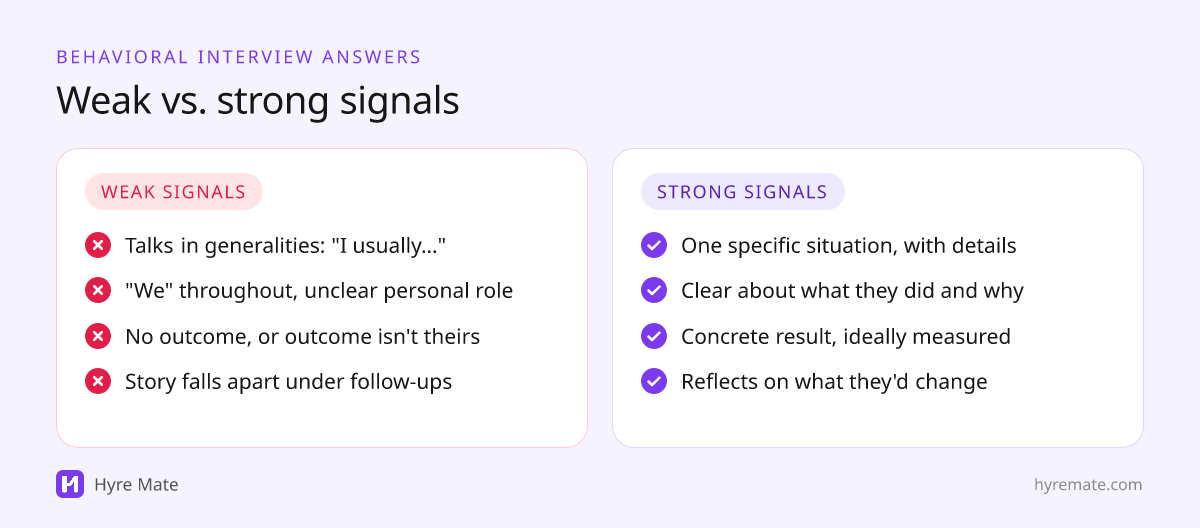
- Strong answers say "I", include specifics and end with an outcome. Weak answers stay general.
- Score each answer against written anchors before you discuss the candidate with anyone.
What are behavioral interview questions?
Behavioral interview questions ask a candidate to describe a real situation from their past and explain what they did. "Tell me about a time you disagreed with your manager" is behavioral. "How would you handle a disagreement with your manager?" is not: that's a situational question, which asks the candidate to imagine a scenario.
Both have their place, but behavioral questions ask for evidence rather than intentions. Most candidates know the right answer to a hypothetical. Fewer can describe, in detail, a time they actually did the right thing. That's why behavioral questions are a core part of most structured interviews.
Why do behavioral interview questions work?
A résumé tells you what someone was responsible for. A behavioral question tells you how they operated. Three things make the format useful:
- They ask for specifics. "I'm a great team player" is a claim. A story about resolving a specific conflict, with names, steps and an outcome, is evidence you can weigh.
- They're hard to bluff for long. A rehearsed answer often falls apart after two or three follow-up questions about what exactly happened and why.
- They map to competencies. Each question targets one quality the job needs, so answers can be scored against the same criteria for every candidate.
They work best inside a structured process: the same questions for every candidate, planned follow-ups and a rating scale. Research on hiring methods consistently ranks structured interviews among the most predictive tools available, well ahead of unstructured conversations.
How do you evaluate answers with the STAR method?
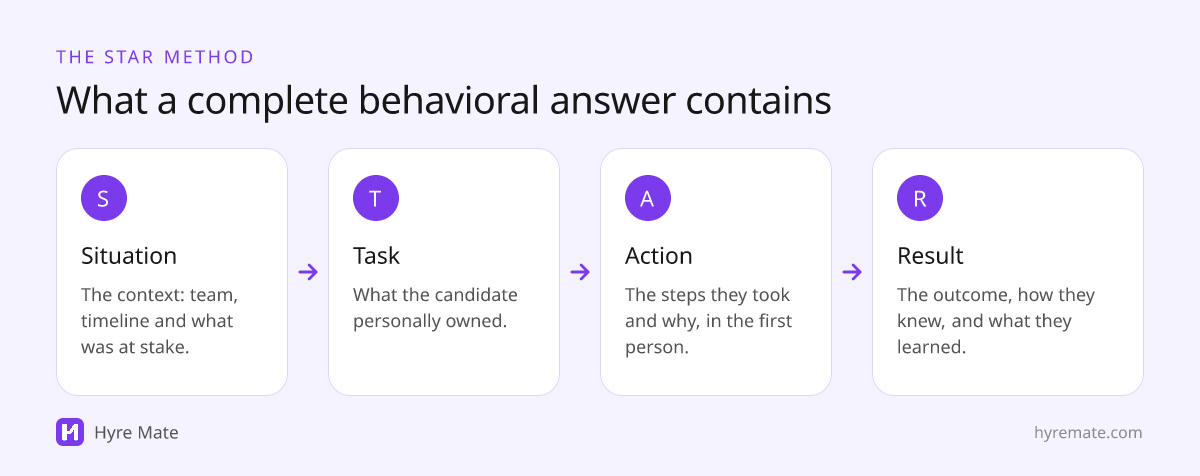
STAR stands for situation, task, action and result. Candidates are often coached to answer this way, but it's just as useful for interviewers as a checklist of what a complete answer contains:
| Part | What to listen for | Probe if it's missing |
|---|---|---|
| Situation | Enough context to understand the stakes: team, timeline, constraints | "What was going on at the time?" |
| Task | What the candidate personally was responsible for | "What was your role specifically?" |
| Action | The steps they took and why, in the first person | "What did you do next? Why that approach?" |
| Result | The outcome, ideally measurable, and what they learned | "How did it turn out? How did you know?" |
Pay most attention to the action. That's where you learn how the candidate thinks and works. Situations and results are easy to embellish; a detailed, coherent account of what someone did and why is much harder to invent.
30 behavioral interview questions by competency
Pick the competencies your role genuinely needs, then choose two or three questions for each. Don't ask all thirty.
Problem-solving
- Tell me about a problem at work you didn't know how to solve at first. How did you work it out?
- Describe a time you had to make a decision with incomplete information.
- Give me an example of a process you improved. What made you notice the problem?
- Tell me about a time your first solution didn't work. What did you do next?
- Describe the most complex problem you've solved in the last year.
Collaboration and teamwork
- Tell me about a time you disagreed with a teammate about how to do something. What happened?
- Describe a project where you depended on another team. How did you keep it on track?
- Give me an example of helping a colleague who was struggling.
- Tell me about a time a team you were on didn't work well together. What did you do?
- Describe a time you had to work with someone whose style was very different from yours.
Communication
- Tell me about a time you had to explain something complex to someone without your expertise.
- Describe a time you had to deliver bad news to a customer or stakeholder.
- Give me an example of a time you were misunderstood. How did you fix it?
- Tell me about a presentation or proposal that didn't land. What did you change?
- Describe a time you had to persuade someone senior to change their mind.
Ownership and accountability
- Tell me about a mistake you made that affected other people. What did you do about it?
- Describe a time you took on something outside your job description because it needed doing.
- Give me an example of a commitment you couldn't keep. How did you handle it?
- Tell me about a project you led from start to finish. What would you do differently?
- Describe a time you spotted a problem nobody else was dealing with.
Adaptability
- Tell me about a time your priorities changed suddenly. How did you adjust?
- Describe a time you had to learn a new skill or tool quickly.
- Give me an example of a change at work you disagreed with. What did you do?
- Tell me about a time you had to deliver under a much tighter deadline than planned.
- Describe a situation where the plan fell apart halfway through.
Leadership (for people managers)
- Tell me about a time you had to give difficult feedback to someone on your team.
- Describe how you handled an underperforming team member.
- Give me an example of a decision you made that your team didn't like.
- Tell me about someone you helped grow. What did you do specifically?
- Describe a time you had to get a team behind a goal they weren't excited about.
What does a strong answer sound like?
Strong and weak answers to behavioral questions tend to have recognizable patterns:
Here's the difference in practice, for "Tell me about a mistake you made that affected other people":
Weak answer
"I'm a bit of a perfectionist, so sometimes I spend too long on things. We had a deadline once and I was late, but the team understood and we got it done."
Strong answer
"I changed a database setting on a Friday without telling the on-call engineer. On Saturday our checkout slowed down and she spent two hours finding the cause. On Monday I explained what I'd done to the team, rolled the change back properly, and wrote a short checklist for configuration changes that we still use. Since then I announce every production change in our team channel first."
The strong answer names a real mistake, takes ownership, describes specific actions and shows what changed afterwards. The weak one turns a fault into a compliment and has no detail to probe.
Which follow-up questions should you ask?
The first answer is rarely the full story. Planned probes help you get to the evidence without leading the candidate:
- "What was your role specifically, versus the team's?"
- "Walk me through what you did first."
- "Why did you choose that approach over the alternatives?"
- "What was the result? How did you measure it?"
- "What was the hardest part?"
- "Looking back, what would you do differently?"
Use the same probes for every candidate where you can. If a candidate gives you a hypothetical ("I would…"), gently redirect: "Can you think of a time that actually happened?"
How do you score behavioral interview answers?
Score each answer against written anchors that describe what a weak, acceptable and strong answer looks like for that competency. For example, for ownership:
| Score | What the answer shows |
|---|---|
| 1 | Blames others or can't name a real example |
| 2 | Real example, but vague about their own role or the outcome |
| 3 | Clear example; owns the mistake and describes how they fixed it |
| 4 | Owns it, fixes it and changes something so it doesn't happen again |
| 5 | All of the above, and helps the wider team learn from it |
Write down the evidence behind each score, and submit your scores before the debrief. Our interview scorecard template walks through writing anchors for each competency.
What are the most common mistakes with behavioral questions?
- Leading questions. "Tell me about a time you showed great leadership" signals the answer you want. "Tell me about a time you had to get a group to agree" doesn't.
- Accepting "we" answers. Team stories are fine, but keep probing until you know what the candidate did.
- Calling hypotheticals behavioral. "What would you do if…" is situational. It's useful, but it doesn't give you past evidence.
- Asking too many questions. Six questions with real follow-ups beat fifteen shallow ones.
- Questions that invite personal disclosures. Avoid prompts like "tell me about balancing work and family", which steer candidates towards protected topics.
How can AI help with behavioral interviews?
Behavioral is one of the ten interview types Hyre Mate supports. The AI interview copilot generates an opening set of questions from the role, then gives you more, similar or follow-up questions on demand, which is useful for building your question bank and probes.
If you record the interview with the candidate's consent, you get a speaker-labeled transcript, AI notes and scores for technical skills, communication, problem-solving and cultural fit, plus strengths and weaknesses for each. The transcript makes it easy to check whether an answer really covered the action and the result, instead of relying on memory.
Frequently asked questions
What is the difference between behavioral and situational interview questions?
Behavioral questions ask about real past situations ("Tell me about a time you…"). Situational questions describe a hypothetical scenario and ask what the candidate would do. Behavioral questions give you evidence of past behavior; situational questions are useful when candidates may not have faced the situation before.
How many behavioral questions should you ask in an interview?
Around six to eight in a 45 to 60 minute interview is typical: two or three for each of the competencies that round owns, with time for follow-up probes and the candidate's own questions.
What is the STAR method?
STAR stands for situation, task, action and result. It's a structure for answering behavioral questions, and interviewers can use it as a checklist to see whether an answer is complete and which part to probe.
What is a good answer to "tell me about a time you failed"?
A good answer describes a real failure, takes ownership without blaming others, explains specifically what the candidate did to fix or limit the damage, and shows what they changed afterwards.
Can you use behavioral questions with entry-level candidates?
Yes. Let candidates draw on school projects, part-time jobs, volunteering or personal projects. If they don't have a relevant example, a situational question can fill the gap.
Are behavioral interview questions legal?
Yes, as long as they're job-related and asked consistently. Avoid wording that invites candidates to discuss protected characteristics such as family status, health, religion or age.